

Written by Dr. Kaneez Fatima, Pharm-D | Last updated: 24 September, 2026
If you landed here after seeing a GlucoTrust ad, video, or influencer post and you're now typing "GlucoTrust reviews" into a search bar to find out whether it's actually legitimate, that's the right instinct. Bottles cost $49 to $69 or more, so it pays to check before you spend. This is an independent review, and it contains an affiliate link: if you buy GlucoTrust through the link in this article, slimglowdr.com may earn a commission at no extra cost to you. That relationship doesn't change what we tell you here. The disclosure is repeated beside each purchase link, in line with FTC's affiliate disclosure guidelines .
Our goal in this GlucoTrust review is to lay out what's actually in the formula, what the evidence does and doesn't support, what it costs, and the trade-offs that most promotional pages leave out, including a refund policy that isn't stated consistently on the brand's own site and a market crowded with look-alike domains. We approach every product review the same way: separate evidence for individual ingredients from evidence for the finished product, disclose any financial relationship up front, and say plainly where the evidence is thin rather than filling the gap with marketing language.
How we researched this review: on 24 September, 2026, we searched PubMed and ClinicalTrials.gov for "GlucoTrust" and for each named ingredient alongside blood glucose, HbA1c and type 2 diabetes, and reviewed the sales page and the label or Supplement Facts panel at https://getglucotrust.co/ .
Quick Answer
No published clinical trial has tested GlucoTrust itself. It is built around ingredients such as Gymnema sylvestre, chromium, cinnamon, and zinc, some of which have real (if mixed) research for blood-sugar markers, but the doses in this product aren't shown on the sales page, so those studies can't be matched to what's in the capsule. It is a real, purchasable supplement, but its maker, official site, and refund terms are hard to verify. It's not a treatment for diabetes and not a replacement for diet, exercise, or medical care.
[VISUAL PLACEHOLDER: Pros/cons snapshot box for GlucoTrust. Alt text: "GlucoTrust pros and cons summary box."]
| Pros | Cons |
|---|---|
| Several individual ingredients (Gymnema sylvestre, zinc, chromium, cinnamon) have supporting clinical research for blood-sugar markers | The proprietary blend as a whole has never been independently clinically trialed |
| Widely studied ingredients (zinc, chromium, cinnamon) have documented safety limits and interactions you can check. | Per-ingredient doses aren't disclosed on the product page, so you can't compare against studied amounts |
| A "100% money-back guarantee" is advertised | The refund window is stated inconsistently on the brand's own site (60 days in one place, 180 days in another) |
| Eight ingredients are named on the product page, so most of the label can be checked against the research | Multiple similarly named domains exist, and scam-callout content about the brand circulates online |
Key Takeaways
- No published clinical trial has tested the actual GlucoTrust capsule; the research behind it applies to individual ingredients studied on their own, often at different doses.
- Evidence strength varies by ingredient: Gymnema sylvestre and zinc have the most consistent supporting research, chromium and cinnamon are mixed, and at least one commonly used blood-sugar ingredient (bitter melon) has null results in the strongest available meta-analysis.
- GlucoTrust's own product page displays two different refund windows, so confirm the current terms directly at checkout before you buy.
- Buy only through a link you trust; the GlucoTrust name is used by several look-alike domains.
- This is not a treatment for diabetes and not a substitute for talking to your doctor, especially if you take glucose-lowering medication.
What Is GlucoTrust?
Positioned around ingredients traditionally associated with glycemic control and insulin sensitivity, this is a blood sugar support supplement marketed directly to consumers online in capsule form. The product page names Digistore24 Inc. as the retailer and payment processor handling the purchase. The name "James Walker" is given as GlucoTrust's creator, alongside a company called Maximum Edge Nutrition, almost only on promotional pages. Neither is confirmed on the product page or in any independent filing we could find, so we can't tell you who makes it.
It's worth being clear about what GlucoTrust is not: it's a dietary supplement, not a drug. Under U.S. law, dietary supplements are regulated as a category of food under DSHEA (the Dietary Supplement Health and Education Act of 1994), which means the FDA does not review or approve them for safety or effectiveness before they reach the market. See how the FDA regulates dietary supplements for the agency's own consumer guidance on this point. Manufacturers are legally responsible for making sure their products are safe and that label claims are truthful. GlucoTrust's label carries the standard supplement disclaimer that its statements have not been evaluated by the FDA and that it isn't intended to diagnose, treat, cure, or prevent any disease.
Context matters here. According to NIDDK and CDC’s National Diabetes Statistics Report, an estimated 97.6 million U.S. adults have prediabetes, meaning blood glucose that's higher than normal but not yet in the diabetic range. That's a large part of the audience GlucoTrust's marketing speaks to, alongside people already diagnosed with diabetes, and it's also the audience for whom lifestyle change, not a supplement, remains the first-line, evidence-based approach for improving blood sugar and reducing progression to type 2 diabetes. If you want more on the broader picture, our guide covers everyday habits that support metabolic health without relying on any single product.
GlucoTrust Ingredients: What's Actually Inside
Full Ingredient List and Evidence at a Glance
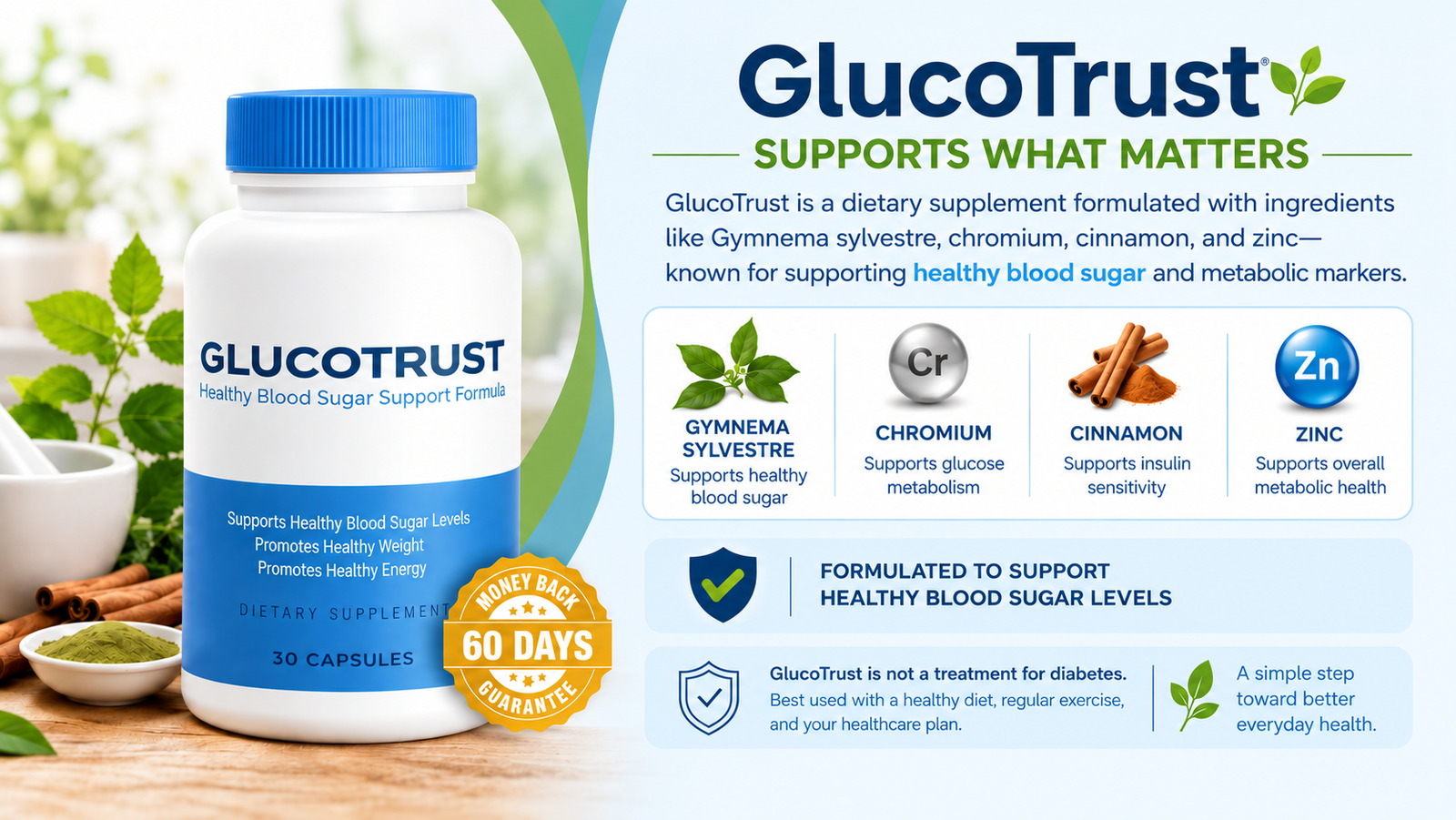
GlucoTrust's own product page names eight ingredients: Gymnema sylvestre, biotin, chromium, manganese, licorice root, cinnamon, zinc, and juniper berries. Only four of those are herbs (Gymnema, licorice root, cinnamon, and juniper); biotin, chromium, manganese, and zinc are a vitamin and minerals. The page nonetheless describes the formula as "a blend of 15 herbs" without naming all fifteen, so the count doesn't add up and some components aren't named at all.
[VISUAL PLACEHOLDER: Ingredient evidence table for GlucoTrust. Alt text: "Table of GlucoTrust ingredients with evidence strength and key caution."]
| Ingredient | Evidence for blood sugar | Key caution |
|---|---|---|
| Gymnema sylvestre | Most consistent: 2021 meta-analysis in type 2 diabetes | Can add to glucose-lowering drugs; low blood sugar risk |
| Biotin | Only at 2 to 15 mg a day, far above normal intake | High doses can distort lab results (troponin, thyroid) |
| Chromium | Mixed; some trials show no effect | May add to glucose-lowering effect |
| Manganese | No high-quality glucose data found | Amount matters; check the label |
| Licorice root | Some human and animal data, limited | Can raise blood pressure and lower potassium |
| Cinnamon | Mixed: modest fasting-glucose effect, mostly no HbA1c effect | Cassia type: coumarin and liver caution at high doses |
| Zinc | Comparatively consistent, especially in overweight adults | Can bind some medications (e.g. levothyroxine); upper intake limit applies |
| Juniper berries | Limited blood-sugar research found | Little human data either way |
Exact milligram amounts weren't shown on the vendor's page at the time of this review. Without doses you can't compare the product to the amounts used in the research below, which limits how much weight any single study deserves.
What the Evidence Says: Individual Ingredients vs. the Proprietary Blend
This is the most important part of the review: we found no systematic review, meta-analysis, or clinical trial of the GlucoTrust capsule itself. Every piece of research below tested an ingredient on its own, usually at a specific studied dose, often in people with diagnosed type 2 diabetes rather than the general prediabetic or weight-conscious population GlucoTrust markets to. Evidence for an ingredient in isolation is not evidence that the finished product works, and the strength of that evidence varies a lot from ingredient to ingredient.
Gymnema sylvestre has the most consistent supporting research in this formula. A 2021 systematic review and meta-analysis in Phytotherapy Research, covering 10 studies and 419 participants, found research on Gymnema Sylvestre and blood sugar associated with measurable improvements in fasting blood glucose, postprandial glucose, and HbA1c in people with type 2 diabetes, at doses such as 600 mg per day in some trials. GlucoTrust's actual Gymnema dose isn't disclosed, so we can't confirm it matches that. Trials typically use standardized extracts, so a dose that doesn't name the extract type says little.
Zinc is the other comparatively strong performer. Meta-analyses have linked zinc supplementation to improved fasting glucose, HOMA-IR, HbA1c, and post-meal glucose, particularly in overweight or obese populations. Again, this reflects a population-level effect from studied doses, not a test of GlucoTrust's specific formulation.
Chromium and cinnamon sit in mixed territory. Per the NIH Office of Dietary Supplements' own summary of chromium's role in insulin sensitivity, some meta-analyses show modest improvement in insulin resistance and fasting blood sugar, while other randomized, placebo-controlled trials, including a six-month trial in at-risk adults, found no significant effect at all. Cinnamon shows a similar split: several meta-analyses report modest fasting-glucose reductions with more than 1.5 grams per day, in trials lasting two months or less, but most find no meaningful effect on HbA1c, the marker that reflects longer-term control. High-coumarin cassia cinnamon also carries a liver-safety caveat at high doses, which is worth knowing if you're combining multiple cinnamon-containing products.
Bitter melon isn't among the eight ingredients named on GlucoTrust's product page, although some other sites list it for similar products. For context, a 2023 systematic review and meta-analysis of nine studies and 414 patients found no statistically significant effect over placebo on fasting glucose or HbA1c, so it shouldn't be assumed to be part of the picture here.
Licorice root has shown improvements in fasting blood sugar, insulin, and lipid markers in some human and animal studies, including a randomized trial pairing licorice extract with a low-calorie diet in women with PCOS. But licorice that contains glycyrrhizin can raise blood pressure and lower potassium with prolonged or high-dose use, which matters enough that we cover it again in the safety section below. [CONFIRM: the product page lists "licorice root" without saying whether it is deglycyrrhizinated (DGL); if it doesn't say, assume it contains glycyrrhizin.]
Biotin is associated in a systematic review and meta-analysis with reduced fasting glucose, total cholesterol, and triglycerides in people with type 2 diabetes, but only at pharmacological doses of 2 to 15 milligrams per day, far above the roughly 30-microgram Adequate Intake most people get from a standard multivitamin. Because GlucoTrust doesn't disclose its exact biotin dose, we can't confirm whether it reaches the range where this evidence applies. The FDA has also warned (Safety Communication, 2017, updated 2019) that high-dose biotin can cause falsely high or falsely low results on some lab tests, including troponin and thyroid tests, so tell your doctor and lab if you take it.
Manganese and juniper berries are also on the label, but we didn't find high-quality clinical research specifically tying either one to blood-glucose outcomes in the sourcing for this review, so we're not going to overstate their role here.
Does GlucoTrust Work? Reviewing the Evidence
Some ingredients have supporting evidence, but the finished product hasn't been tested, so there's no direct evidence that the capsule "works". At most it may support blood-sugar management as part of a broader routine; it won't normalize blood sugar or replace medication.
Understanding how blood sugar and insulin sensitivity work helps explain why a supplement alone rarely tells the whole story: insulin resistance develops over years, and it responds most consistently to sustained changes in diet, activity, sleep, and weight, with medication or supplementation playing a supporting role for many people, not a replacement role. Building that foundation first, through consistent movement, a lower-glycemic eating pattern, adequate sleep, and stress management, is a useful starting point alongside, or instead of, any supplement decision.
GlucoTrust Side Effects and Safety Considerations
There's no independently published clinical trial of GlucoTrust that documents an official side-effect profile for the finished product. What we can responsibly say comes from the ingredients themselves.By ingredient: Gymnema sylvestre can cause stomach upset and, alongside glucose-lowering drugs, low blood sugar; chromium can occasionally cause stomach upset or headache; and zinc can cause nausea, while long-term high intake can lower copper levels. Licorice root's documented tendency to raise blood pressure and lower potassium with prolonged or high-dose use is a genuine consideration, particularly for anyone with existing hypertension. High-dose cinnamon, especially the cassia variety, carries a liver-safety caveat that's more relevant with long-term, high-intake use than with a single supplement serving, but it's still worth knowing.
Who Should Talk to a Doctor First
This is the section we'd consider non-negotiable: talk to your doctor, pharmacist, or another healthcare professional before starting GlucoTrust, especially if you take medication for diabetes.
Here's why that matters specifically for this category of supplement. Several ingredients in blood-sugar blends, including chromium, Gymnema sylvestre, and cinnamon, can independently affect blood glucose. Combining them with prescription glucose-lowering medications such as metformin, sulfonylureas, or insulin could compound the glucose-lowering effect and raise the risk of hypoglycemia (blood sugar dropping too low). This is a general pharmacological caution based on how these ingredients behave, not a finding specific to GlucoTrust, but it applies to GlucoTrust as much as to any similar product.
As a pharmacist, these are the specific points I'd check before someone starts a product like this:
- Low blood sugar: watch for shakiness, sweating, confusion, or unusual hunger, especially if you take a sulfonylurea or insulin.
- If you take levothyroxine, ask your prescriber about spacing: zinc and other minerals can reduce its absorption, and roughly four hours apart is the usual advice.
- If you take a diuretic or digoxin, licorice's effect on potassium matters, so ask before starting.
- Tell your prescriber and the lab that you take biotin before blood tests, because it can distort some results.
- Tell your surgeon or dentist about any herbal supplement before a procedure.
Bring the bottle or a photo of the label to your pharmacist so every ingredient can be checked against your medications.
You should also check in with a doctor first if you have high blood pressure (given licorice root's effect), are pregnant or breastfeeding, have an existing liver or kidney condition,As a pharmacist, these are the specific points I'd check before someone starts a product like this:[M1]
- Low blood sugar: watch for shakiness, sweating, confusion, or unusual hunger, especially if you take a sulfonylurea or insulin.
- If you take levothyroxine, ask your prescriber about spacing: zinc and other minerals can reduce its absorption, and roughly four hours apart is the usual advice.
- If you take a diuretic or digoxin, licorice's effect on potassium matters, so ask before starting.
- Tell your prescriber and the lab that you take biotin before blood tests, because it can distort some results.
- Tell your surgeon or dentist about any herbal supplement before a procedure.
Bring the bottle or a photo of the label to your pharmacist so every ingredient can be checked against your medications.
You should also check in with a doctor first if you have high blood pressure (given licorice root's effect), are pregnant or breastfeeding, have an existing liver or kidney condition, scheduled for surgery, or are already taking multiple supplements that could stack similar effects. None of this means GlucoTrust is unsafe for everyone; it means the people for whom caution matters most are identifiable, and it's worth five minutes with a healthcare provider to find out if you're one of them.
GlucoTrust Price, Packages, and Value
Pricing drops meaningfully the more bottles you commit to, across three package sizes sold directly through the product page.
[VISUAL PLACEHOLDER: Price/package comparison table for GlucoTrust. Alt text: "GlucoTrust package pricing comparison table."]
| Package | Price Per Bottle | Total Cost | Shipping |
|---|---|---|---|
| 1 bottle (30-day supply) | $69 | $69 | +$9 shipping |
| 3 bottles (90-day supply) | $59 | $177 | Free |
| 6 bottles (180-day supply) | $49 | $294 | Free |
Pricing verified directly from the vendor's product page as of publication; prices and promotions can change, so confirm current figures before you buy.
The single-bottle option is the highest per-unit cost and the lowest commitment, which makes sense if you're trying GlucoTrust for the first time and want to see how you tolerate it before buying in bulk. The three- and six-bottle packages meaningfully lower the per-bottle price, but they also mean more money at risk if the product doesn't work for you, which is exactly why the refund policy below matters more than it would for a low-cost trial purchase.
GlucoTrust Refund Policy: And Reported Friction
GlucoTrust advertises a "100% money-back guarantee," but here's something every reader should know before ordering: GlucoTrust's own product page is not internally consistent about how long that guarantee lasts. In one place on the site, the refund window is listed as 60 days; in another place on the same page, it's listed as 180 days. We could not find an independent source that resolves which figure is currently accurate, and it isn't our place to pick the more favorable number and present it as settled fact. The responsible advice is simple: before you buy, confirm the exact, current refund window directly at checkout or with customer support, and keep a copy of whatever terms are shown to you at the time of purchase.
Beyond that inconsistency, some third-party reviewers and consumer complaint threads allege difficulty getting refunds honored or unexpected charges tied to multi-bottle or autoship-style billing. We were not able to independently verify the scale of this pattern through an authoritative, citable source, so we're not going to cite a specific complaint count or percentage; those numbers don't exist in a form we can stand behind. What we can say is that the refund-window inconsistency on the brand's own page is itself a legitimate, directly observable transparency gap, and it's reason enough to get everything in writing (a confirmation email, a screenshot of the terms shown to you) before you complete a purchase, especially a multi-bottle one.
Not sure yet whether this is worth the risk? Read GlucoTrust's refund policy again before deciding, or keep reading for the legitimacy and pricing details below.
Is GlucoTrust Legit? BBB Rating, Complaints, and Scam Claims
This is probably the question that brought you here, so let's address it directly rather than dancing around it. GlucoTrust is a real, purchasable product, which is different from a nonexistent one. But a payment processor doesn't vouch for a product, and "real" isn't the same as "trustworthy". The marketing ecosystem around it has genuine problems: look-alike sites, a founder story we couldn't trace to a verifiable person, and scam-callout content
On BBB rating specifically: we couldn't find a BBB profile for GlucoTrust itself. The only related profile is the BBB profile for the company reported to manufacture GlucoTrust not BBB accredited, no letter grade, three complaints closed in the last three years, and no customer reviews. It doesn't name GlucoTrust, so treat the connection as reported, not confirmed.
On the scam question: search results for GlucoTrust do include scam-warning content and callouts alleging things like fake celebrity endorsements implying public figures endorsed the product when they hadn't. We're not going to repeat specific unverified claims from those sources as fact, because we couldn't confirm the details ourselves, but we also won't pretend that content doesn't exist. If you've seen an ad or article that felt off, that instinct is reasonable; it's part of why buying through a verified link and reading the actual label matters more than trusting whichever ad you saw first.
Where to Buy GlucoTrust Safely: Official vs. Look-Alike Domains
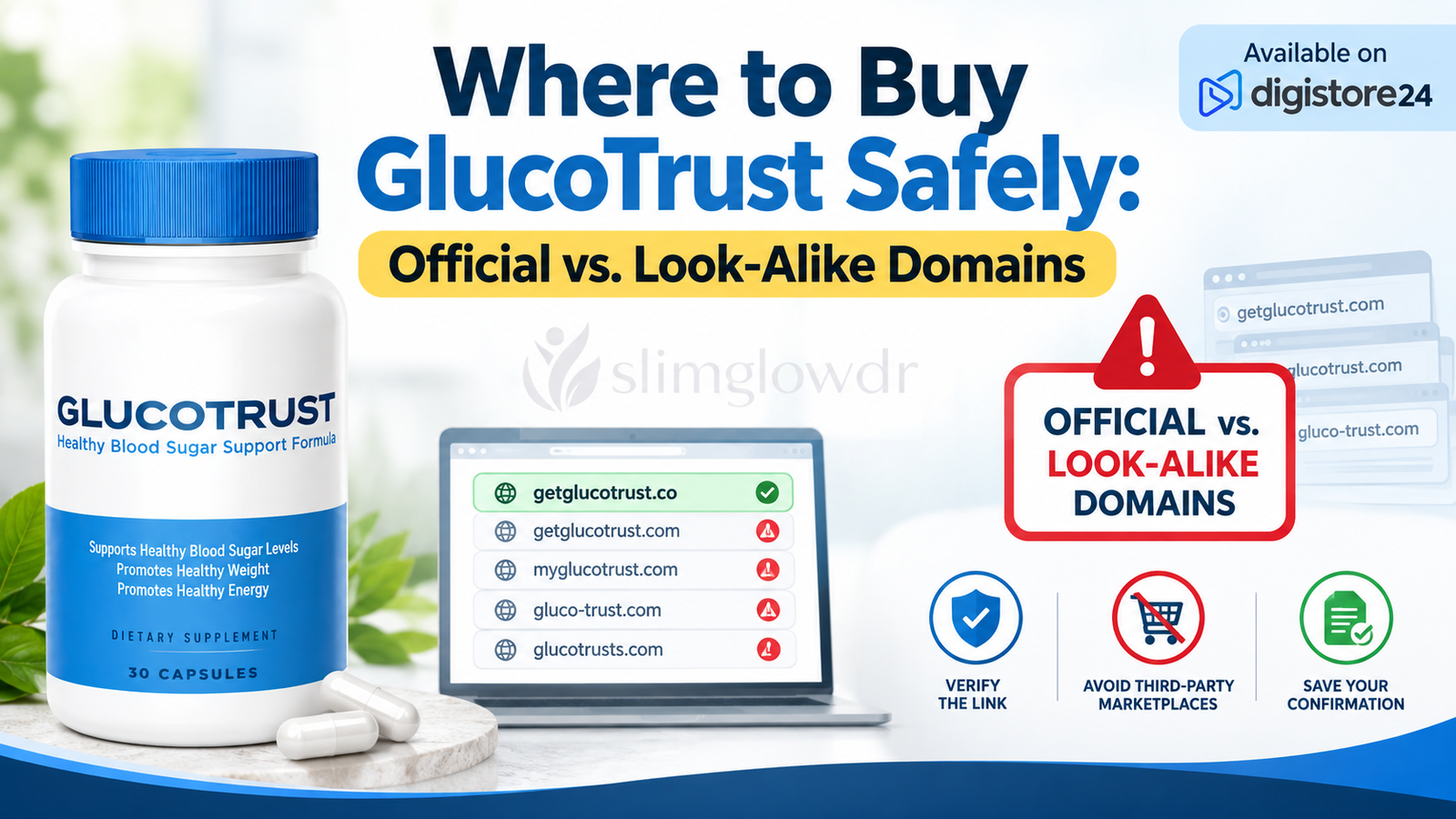
One of the messiest parts of this market is that GlucoTrust's official website isn't a single, obvious address. Several similarly named domains, including variations like getglucotrust.com, myglucotrust.com, gluco-trust.com, and others using slightly different prefixes, present themselves as GlucoTrust's home online. That creates a real risk: ordering from the wrong domain can mean paying full price for a possible counterfeit, hitting a billing structure you didn't agree to, or simply having no clear path to a refund if something goes wrong.
[VISUAL PLACEHOLDER: "Official vs. look-alike domains" warning callout box. Alt text: "Warning callout on GlucoTrust look-alike purchase domains."]
Before you buy, protect yourself:
- Purchase only through a link you've verified, and avoid clicking unfamiliar domains from random ads or search results.
- Never buy GlucoTrust from an unverified third-party marketplace listing; these carry real counterfeit and expired-product risk that the manufacturer's own guarantee likely won't cover.
- Save your order confirmation and any stated refund terms at the moment of purchase, given the refund-window inconsistency covered above.
The link below is the one we checked: https://getglucotrust.co/, processed through Digistore24. It follows the same naming pattern as the look-alike domains above, and we can't confirm it is the manufacturer's official site. If you can't verify a seller yourself, check the seller name and refund terms on the checkout page before you pay.
You can Check GlucoTrust's Current Price and Availability here.
GlucoTrust Reviews: What We Could and Couldn't Find
We looked for a large, independently aggregated dataset of GlucoTrust customer reviews and didn't find one we could cite with confidence, so take the themes below as general patterns visible across public comments and marketing pages rather than a verified statistic.
Individual results vary by starting point, consistency of use, and what else someone is doing for their blood sugar, and no testimonial, positive or negative, substitutes for the ingredient-level evidence above. We haven't quoted GlucoTrust's own testimonials or before-and-after photos, because we couldn't verify who wrote them or that they show typical results.
Our Verdict: Is GlucoTrust Worth Buying?
Here's where we land: GlucoTrust is a real, purchasable supplement with some genuinely supportive research behind individual ingredients like Gymnema sylvestre and zinc. But the finished product is unproven, its per-ingredient doses aren't shown, its maker and official site can't be verified, and its refund terms need to be confirmed in writing before you pay. On that evidence we can't recommend it as a good buy; it's an unproven product with avoidable risks.
The only situations where it's worth considering:
- You already have a solid diet, activity, and sleep foundation in place
- You're not on medication that interacts with blood-sugar-lowering ingredients, or you've cleared it with your doctor if you are
- You're buying through a verified link with realistic expectations about what a supplement can and can't do
- The label or checkout page shows per-ingredient amounts and a refund window you've confirmed in writing
Skip it, or ask your pharmacist or doctor first, if:
- You're looking for a standalone fix rather than a complement to lifestyle changes
- You're currently on diabetes medication and haven't talked to your doctor yet
- You have high blood pressure and haven't accounted for the licorice-root caveat
It's also worth knowing that GlucoTrust isn't the only branded blood-sugar supplement we've put through this same kind of review. If you're comparison-shopping rather than committed to this specific product, take a look at our Blood Sugar Blaster review and our InsulinHerb Berberine V2 review. We treat GlucoTrust as one option among several we've evaluated with the same evidence bar, not as a single "best" pick, and reading more than one review before you spend $50 to $70 or more is a reasonable way to shop.
If, after the caveats above, you still want to check the current price, this is the link we reviewed. It is an affiliate link, and slimglowdr.com may earn a commission at no extra cost to you if you purchase through it. On this evidence we don't rate GlucoTrust a recommended buy. You can Check GlucoTrust's Current Price and Availability here.
Conclusion
.GlucoTrust is a real supplement built on ingredients with uneven research behind them, not a proven treatment or a fix for blood sugar. Until its doses, maker, and refund terms can be verified, we'd treat it as unproven and put diet, activity, and medical care first. If you have prediabetes, borderline blood sugar, or take diabetes medication, talk to your pharmacist or doctor before adding any new supplement.
.Before you order, bring the label and these questions to your pharmacist or doctor: Could any ingredient interact with my medications? Could it push my blood sugar too low alongside my treatment? Could it affect my blood pressure or potassium? Do I need to tell my lab about biotin before my next blood test?
Frequently Asked Questions
Is GlucoTrust a scam or legit?
GlucoTrust is a real, purchasable supplement, but "real" isn't the same as "trustworthy". Its maker, official site, and refund terms are hard to verify, its per-ingredient doses aren't shown on the sales page, and the market around it includes look-alike domains and unverified scam-callout content. We treat it as unproven.
Does GlucoTrust really work for blood sugar?
Some individual ingredients in GlucoTrust have research supporting blood-sugar benefits at studied doses, but the finished GlucoTrust formula itself has never been independently clinically tested. It may support blood-sugar management as part of a broader routine, but there's no guarantee it will work for any given person.
What are the side effects of GlucoTrust?
There's no published clinical trial documenting an official side-effect profile for GlucoTrust itself. Based on its ingredients, possible considerations include mild digestive upset, a blood-pressure-raising effect from licorice root with prolonged use, and interaction risk with diabetes medications.
What ingredients are in GlucoTrust?
GlucoTrust's product page lists Gymnema sylvestre, biotin, chromium, manganese, licorice root, cinnamon, zinc, and juniper berries, describing the overall formula as a blend of 15 herbs without naming every component individually, although only four of the eight named ingredients are herbs.
How much does GlucoTrust cost, and what are the package prices?
As of publication, GlucoTrust costs $69 for a single bottle plus $9 shipping, $59 per bottle ($177 total, free shipping) for a three-bottle package, or $49 per bottle ($294 total, free shipping) for a six-bottle package. Prices can change, so confirm current figures at checkout.
Is it safe to buy GlucoTrust from third-party sellers?
We'd advise against it. Unverified third-party marketplace listings carry real counterfeit and expired-product risk, and buying outside a verified link can also complicate any refund claim.
Is GlucoTrust FDA approved?
No, and no dietary supplement is "FDA approved" in that sense. Under U.S. law, supplements are regulated as food, and the FDA does not review or approve them for safety or effectiveness before sale. GlucoTrust's own label carries the standard disclaimer that its statements haven't been evaluated by the FDA and that it isn't intended to diagnose, treat, cure, or prevent any disease.
Can I get a refund if GlucoTrust doesn't work for me?
GlucoTrust advertises a "100% money-back guarantee," but its own website lists two different refund windows, 60 days in one place and 180 days in another. Confirm the exact, current terms directly at checkout or with customer support before you buy, and keep written confirmation of whatever policy you're shown.
Is GlucoTrust safe to take with diabetes medication?
Talk to your doctor before combining GlucoTrust with any glucose-lowering medication. Ingredients like chromium, Gymnema sylvestre, and cinnamon can independently affect blood glucose, and stacking them with prescription medication could increase the risk of hypoglycemia.
How long does it take to see results with GlucoTrust?
There's no independently verified timeline for GlucoTrust specifically. The ingredient research it draws on generally used trial periods of eight weeks to several months, so if you try it, a similarly patient timeframe, alongside diet and activity changes, is a more realistic expectation than a quick fix.
What is GlucoTrust's BBB rating, and are there complaints?
The only findable BBB profile plausibly connected to GlucoTrust belongs to Maximum Edge Nutrition, the company widely (but not independently) reported to manufacture it. That profile shows no BBB accreditation, no letter-grade rating, and three complaints closed over three years. It's worth noting that this profile doesn't name GlucoTrust directly, so treat the connection as reported rather than confirmed.
Does GlucoTrust contain bitter melon?
Not on the ingredient list on the product page we reviewed, although some other sites list it for similar products.
How can I tell whether a GlucoTrust website is official?
You often can't from the domain alone, because several similarly named sites present themselves as official. Check the seller name and refund terms on the checkout page, take screenshots, and treat conflicting refund terms between two sites as a warning sign.