

Reviewed by Dr. Kaneez Fatima, Pharm-D, for Slim Glow Dr. Last updated: September 5, 2026.
If you landed here after watching a Blood Sugar Blaster video ad or clicking through from an affiliate link, you're probably not looking for another sales pitch. You want to know what's actually in this supplement, whether the ingredients have any real research behind them, what it costs once you get past the headline price, and whether the "Mat Carter, MD" backstory and manufacturer name check out. This review answers all of that as plainly as the available evidence allows, including the parts where the evidence runs out.
Affiliate disclosure: This article contains an affiliate link. If you buy Blood Sugar Blaster through it, Slim Glow Dr may earn a commission at no extra cost to you. That relationship does not change the analysis below; where the evidence is thin, contested, or unverifiable, we say so. This disclosure follows FTC's rules on affiliate disclosure, placed here before any product claim rather than buried in a footer.
If you just want to see current pricing and the official guarantee terms before reading the full breakdown, you can check the official Blood Sugar Blaster pricing and guarantee page directly.
Quick Answer: Does Blood Sugar Blaster Really Work?
No published clinical trial has tested the Blood Sugar Blaster formula itself, and several of its per-serving doses are lower than the amounts used in the studies its marketing references. Given that evidence gap, treat it as an unproven, ingredient-inspired blend rather than a demonstrated treatment: it contains several ingredients (cinnamon bark, chromium, berberine in some formula descriptions, bitter melon, and others) that have been studied independently for blood-sugar-related outcomes, with mixed results depending on the ingredient, dose, and study. It may be a reasonable adjunct for general blood-sugar support in people without diagnosed diabetes, but it is not a substitute for medication, and individual results vary.
Key Takeaways
- Evidence status: Support exists at the ingredient level (cinnamon, chromium, berberine, bitter melon, and others), not the product level. No clinical trial has tested the Blood Sugar Blaster formula as a whole.
- Ingredient list is contested: The manufacturer's own product listing does not include berberine or vanadium, while several third-party review sites describe a version of the formula that does. We could not resolve this discrepancy.
- Notable safety flags: Licorice root can raise blood pressure in some people, and guggul can interact with thyroid medication. Anyone on glucose-lowering or blood-pressure medication should talk to a prescriber before adding this or any similar supplement.
- Price and guarantee: $69 for one bottle, $59/bottle for three, $49/bottle for six, with free shipping and a 60-day, no-questions-asked refund policy per the official sales page at the time of writing.
- Company identity is murky: At least four different company or brand names surface across sources connected to this offer, which we lay out plainly below rather than pick one to state as fact.
- Verdict: A defensible ingredient-level case exists for cautious use as a general blood-sugar-support supplement, but the formula-specific evidence, formulator credential, and manufacturing transparency all fall short of what the marketing implies.
What Is Blood Sugar Blaster?
Blood Sugar Blaster is a dietary supplement marketed as a blend of herbs, minerals, and amino acids intended to support healthy blood sugar levels. It's sold in capsule form, direct-to-consumer, primarily through video sales letter (VSL) style marketing that walks viewers through a formulator origin story before presenting the product.
Who Makes It?
Researching who actually makes Blood Sugar Blaster turns out to be one of the more genuinely confusing parts of this review. Several third-party review sites name the manufacturer as "Vitality Nutrition," but we could not find that name on any first-party page connected to the product. Instead, the live sales page's own contact information lists the operating company as "My Blood Sugar Blaster," with returns handled by Shipoffers, a real third-party fulfillment company that publicly works with both ClickBank and Digistore24. Separately, the vendor product listing that hosts the ingredient and supplement-facts panel identifies the company as PremVitality. And the offer's affiliate-support page frames the product as "Kachin Diabetes Solution" (also marketed as Blood Sugar Blaster), with support contacts tied to both Kachin Diabetes Solution and PremVitality.
In other words, at least four distinct names, Vitality Nutrition, My Blood Sugar Blaster, PremVitality, and Kachin Diabetes Solution, are associated with this product across the sources we checked, and no single source ties all four together explicitly.
We're presenting this plainly as an unresolved transparency gap rather than picking one name to state as settled fact. It is not, by itself, proof of fraud; direct-response supplement offers frequently run through multiple corporate entities, fulfillment partners, and affiliate networks. But a reader doing legitimacy due diligence deserves to know that the company behind this product is genuinely difficult to pin down from public information, and that is itself relevant evidence.
Who Is "Mat Carter, MD"?
Blood Sugar Blaster's marketing centers on a formulator named "Mat Carter, MD," described as having trained at the University of Kansas School of Medicine. We attempted to independently verify this credential through general web searches and Kansas physician-licensing search resources and found no public record confirming this individual's licensure or affiliation. That is consistent with third-party observations that reviewers have not been able to verify Carter's backstory or qualifications either.
To be clear about the limits of this finding: the absence of a search result is not proof that the person doesn't exist, and a definitive answer would require directly querying the Kansas Board of Healing Arts license-lookup database, which we could not access interactively in this research pass. What we can say with confidence is that neither the live sales page's contact information nor the vendor's own product page mentions "Mat Carter, MD" at all. Compare that to a competitor like GlucoTrust, whose own site discloses that its "James Walker" formulator persona is a pen name rather than a real physician, a materially more transparent disclosure than anything we found for Blood Sugar Blaster's Carter persona. Treat the marketing bio for "Mat Carter, MD" as an unverified claim, not an established credential.
How Is Blood Sugar Blaster Claimed to Work?
The marketing describes a mechanism built around activating AMPK (a cellular energy-regulating enzyme sometimes called the body's "metabolic master switch") and inhibiting alpha-glucosidase, an enzyme involved in breaking down carbohydrates into glucose during digestion. Both mechanisms are real biological processes discussed in the broader metabolic-health literature, and some individual ingredients in blood-sugar supplements (berberine in particular) have been studied for AMPK-related effects. But this is the manufacturer's framing of how the product is supposed to work, not an independently verified mechanism-of-action study on Blood Sugar Blaster itself. Readers should treat it as a plausible-sounding explanation rather than a demonstrated effect, and as with everything on this page, general nutrition and lifestyle habits, not any single supplement, remain the best-supported way to support healthy blood sugar day to day.
Also Read: https://slimglowdr.com/health/why-metabolism-breaks-after-thirty-fix-it
Blood Sugar Blaster Ingredients and Doses
Before getting into individual ingredients, it's worth stating the ingredient-list problem directly: we could not obtain a single, definitive, current ingredient list for Blood Sugar Blaster. The live sales page defers to a separate "text version" link for its supplement-facts panel that was not accessible in this research pass. The manufacturer's own PremVitality vendor listing provides a supplement-facts table, but that table does not include berberine or vanadium at all, while several independent (and non-authoritative, affiliate-style) third-party review sites describe a version of the formula that includes both. The table below uses the vendor's published label as the primary source, with the berberine and vanadium discrepancy flagged explicitly rather than quietly merged in.
Full Ingredient List and Per-Serving Doses
| Ingredient | Label dose (per PremVitality) | Typical studied dose | Note |
|---|---|---|---|
| Cinnamon Bark Powder | 50 mg | 500-1,000 mg/day (cassia); 1,000 mg/day (Ceylon, strongest result) | Roughly 1/10 to 1/20 of studied amounts |
| Chromium (picolinate, per third-party sources) | 67 mcg | 200-1,000 mcg/day across trials | Mixed trial results at higher doses; see below |
| Guggul | 50 mg (plus an unspecified-amount extract in a proprietary blend) | No established glycemic-specific studied dose | Better studied for cholesterol than blood sugar |
| Banaba Leaf (1% extract) | 25 mg | Varies by corosolic-acid standardization | No confident comparator dose found in available research |
| Zinc (as Zinc Oxide) | 7.5 mg | Often ≥30 mg/day in glycemic trials | Below the adult RDA of ~11 mg/day |
| White Mulberry Leaf | Not specified on label | DNJ-active doses ~6-18 mg; extract doses 1.25-5 g | Fair comparison not possible without a labeled amount |
| Yarrow Flowers Powder | Not specified on label | Limited glycemic-specific human data available | No comparison offered |
| Licorice Root Extract | 50 mg | No standard efficacy dose for blood sugar | Relevant mainly for its safety profile, see Safety section |
| Alpha Lipoic Acid | 30 mg | 600 mg/day+ in neuropathy RCTs | Neuropathy trials, not primarily glycemic control |
| L-Taurine | 25 mg | No confident glycemic comparator dose identified | No comparison offered |
| Gymnema Sylvestre Leaf Powder | 50 mg | Commonly cited 200-400 mg extract range in the literature | Range cited in general literature; exact comparator study not confirmed in this research |
| Bitter Melon (4:1 extract) | 50 mg | Multi-gram raw fruit or several-hundred-mg to multi-gram extract ranges in RCTs | Overall evidence base described as contradictory |
| Magnesium (as Magnesium Oxide) | 50 mg | Considerably higher elemental magnesium doses in glycemic RCTs | Magnesium oxide is also a poorly absorbed form |
| Manganese (Amino Acid Chelate) | 1 mg | No strong glycemic-specific dosing literature found | Likely a trace inclusion, not a claimed active |
| Berberine | Not on PremVitality's label | Commonly 1,000-1,500 mg/day in trials | Some third-party sources list this as an ingredient; the vendor's own label does not |
| Vanadium (Vanadyl Sulfate) | Not on PremVitality's label | ~100 mg/day (~31 mg elemental) in small studies | Same discrepancy as berberine; also carries kidney-safety flags at higher doses |
A pattern is visible across almost every row: where a comparison is possible, Blood Sugar Blaster's labeled doses tend to sit well below the amounts used in the studies its marketing implicitly leans on. That doesn't mean the ingredients do nothing at these doses, dose-response relationships in supplement research are often poorly mapped, but it does mean a reader shouldn't assume that "this ingredient was shown to lower blood sugar in a study" translates directly into "this product, at this dose, will do the same."
Ingredient Doses vs. Doses Used in Published Clinical Studies
Three ingredients illustrate this gap clearly enough to walk through individually.
Cinnamon. A peer-reviewed RCT using Ceylon cinnamon extract at 1,000 mg/day (two 500 mg doses before meals) for 12 weeks in people with type 2 diabetes found a fasting glucose reduction of 78.6 mg/dL versus 11.2 mg/dL in the placebo group. That figure comes from a small type-2-diabetes-only subgroup within the trial (12 people on cinnamon, 15 on placebo) with large standard deviations, meaning individual results within each group varied widely. Across the trial's full 150-person population, the overall result was more modest: a 15.53 mg/dL average decrease versus a 0.39 mg/dL increase in placebo. Both numbers are accurate, but the smaller, more dramatic figure deserves that context before you weigh it. Separately, that's a specific cinnamon species (Ceylon, not cassia) at a dose 20 times higher than Blood Sugar Blaster's labeled 50 mg, and the product's label doesn't specify which cinnamon species it uses. This research on cinnamon and insulin sensitivity contrasts with separate cassia cinnamon RCTs at 1,000 mg/day, which found no significant change in insulin sensitivity, though a single acute 5 g dose did blunt peak post-meal glucose. This species distinction matters beyond dosing too: cassia cinnamon contains meaningfully more coumarin than Ceylon cinnamon, a compound associated with liver-toxicity concern at high or chronic intake, so which type is actually in the capsule is not a trivial detail.
Chromium. An NIH-funded trial of 400 mcg/day chromium picolinate over 12 weeks in prediabetic adults was associated with roughly a 7 mg/dL drop in fasting glucose, a real but modest finding that NIH's review of chromium and blood sugar research describes as being of unclear clinical significance when chromium is used as an adjuvant. A separate 24-week RCT using a higher dose, 1,000 mcg/day, in people with type 2 diabetes found no significant effect on insulin sensitivity or fasting glucose. Blood Sugar Blaster's labeled 67 mcg sits well below both studied doses.
Berberine. This is the ingredient with the strongest independent evidence base in the formula's third-party description; clinical research on berberine and blood sugar, meta-analyses of RCTs, reports meaningful reductions in HbA1c, fasting glucose, post-meal glucose, and insulin resistance markers, typically at doses of 1,000-1,500 mg/day used as an adjunct to standard therapy. The catch: we could not confirm that Blood Sugar Blaster actually contains berberine at any specific dose. The manufacturer's own vendor-page label doesn't list it. If berberine genuinely isn't in the current formula, then this is the single most consequential gap between the product's ingredient-level marketing narrative and what's on the actual label.
Is Blood Sugar Blaster Backed by Science?
Everything else in this review hinges on one distinction, so it's worth being explicit up front: evidence for individual ingredients is not the same thing as evidence for this product. Cinnamon, chromium, berberine, zinc, magnesium, and bitter melon have all been studied in isolation, at specific doses, in specific populations, often with mixed or conflicting results even within a single ingredient (chromium's positive small trial versus its null larger trial is a good example, as is bitter melon's mixed individual-trial results versus an inconclusive systematic review of nine studies and 414 patients).
None of that constitutes evidence that a 14-ingredient proprietary-style blend, at the specific doses Blood Sugar Blaster uses, produces any particular blood-sugar outcome in a real user. No published clinical trial has tested the Blood Sugar Blaster formula itself.
That's not necessarily a red flag unique to this product; most direct-to-consumer supplement blends are never tested as a whole formula. But it does mean the honest verdict has to rest on the ingredient-level evidence above, the transparency (or lack of it) around dosing and sourcing, and the safety picture, not on the AMPK-and-alpha-glucosidase mechanism story the marketing tells.
As with any supplement in this category, it's worth pairing ingredient research with a broader look at diet and lifestyle changes that help manage prediabetes, since those interventions have the deepest and most consistent evidence base for blood-sugar outcomes.
Interested in seeing the current pricing and the full label for yourself? You can see the full ingredient list and current offer on the official site.
Blood Sugar Blaster Side Effects and Safety
Reported Side Effects
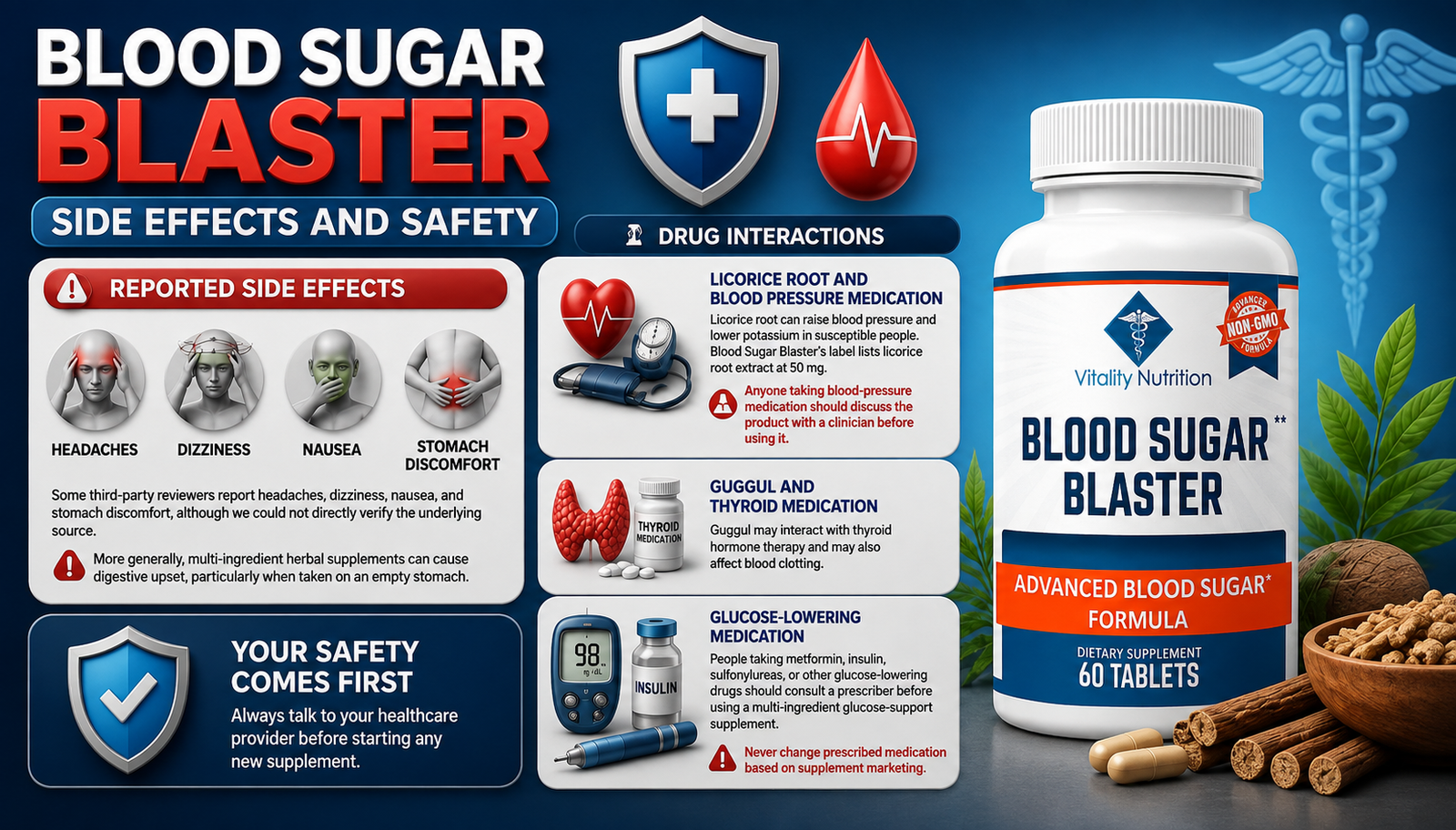
We were not able to directly access one commonly cited third-party "scam investigation" source (its site blocked automated access), so its specific side-effect claims, reported headaches, dizziness, nausea, and stomach discomfort, come to us only via a search-engine summary of that source, not a direct read. We're reporting that as "some third-party reviewers report..." rather than as an independently confirmed finding. More broadly, herbal blood-sugar blends with this many active ingredients (14 by the vendor's own count) carry a reasonable likelihood of mild digestive side effects such as stomach upset, especially when taken on an empty stomach, simply because that's common across multi-ingredient herbal supplements generally, not because of any specific finding about this product.
Drug Interactions: Diabetes Medication, Blood Pressure Medication, Blood Thinners
Of everything in this review, this safety section matters most for the 40-plus audience this product targets, since that age group is disproportionately likely to be on prescription medication already.
- Licorice root and blood pressure medication. NIH's National Center for Complementary and Integrative Health states plainly that even small amounts of glycyrrhizin from licorice can cause serious problems, including elevated blood pressure and low potassium, in people with hypertension, heart, or kidney conditions, and case reports document licorice root's documented blood-pressure risks. Blood Sugar Blaster's label lists licorice root extract at 50 mg. If you take blood pressure medication, this is the single interaction flag in this product worth raising with your prescriber before you start.
- Guggul and thyroid medication. Guggul can interact with thyroid hormone therapy, potentially increasing the hormone's effects or side effects, and it can also slow blood clotting, which is relevant if you take blood thinners.
- Glucose-lowering medication stacking. If you already take metformin, a sulfonylurea, insulin, or another glucose-lowering medication, adding a multi-ingredient herbal blend containing several compounds independently associated with blood-sugar-lowering effects (berberine, if present; chromium; cinnamon) raises a legitimate, if often understated, hypoglycemia risk from stacking multiple glucose-lowering agents at once. This overview of how herbal supplements can interact with diabetes medication covers the broader mechanism.
The consistent, non-negotiable guidance across all three of these: talk to your prescribing clinician or pharmacist before adding this or any similar herbal supplement, and never adjust your prescribed medication on your own based on a supplement's marketing claims.
Is Blood Sugar Blaster Legit, or a Scam?
"Legit" and "scam" aren't quite the right binary for a product like this. A more useful framing is transparency: how much of what the marketing claims can actually be verified against independent, checkable sources? By that measure, Blood Sugar Blaster has real gaps.
Manufacturing Standards and Lab-Testing Transparency
Some Blood Sugar Blaster marketing and third-party copy describe the product as made in an "FDA-approved facility." That characterization is very likely inaccurate. The FDA does not approve dietary supplement manufacturing facilities; it registers food facilities and inspects them for compliance with Current Good Manufacturing Practice regulations under 21 CFR Part 111, issuing inspection observations rather than an approval certificate. We're stating this plainly rather than softening it: "FDA-approved" is the wrong term for whatever manufacturing oversight this product actually has, and we found no independently verifiable third-party lab testing or Certificate of Analysis (COA) for Blood Sugar Blaster in this research pass. That absence doesn't prove the product is contaminated or mislabeled, but a reader specifically looking for third-party-verified purity or potency testing will not find it here.
What Do Independent Reviews and Complaints Say?
We did not test this product ourselves, and we want to be explicit about that rather than manufacture a first-person "we tried it for 90 days" narrative the way some competing review sites do; that kind of narrative is not something we're willing to fabricate. What we can report is sourced from third parties. One entity connected to this offer, "Kachin Diabetes Solution," carries a Better Business Bureau profile based in Miami, Florida, opened in 2019, with an A+ rating and no BBB accreditation (the BBB itself notes many legitimate businesses choose not to seek accreditation). We couldn't retrieve specific complaint counts or themes from that profile in this pass. It's also worth flagging directly: that BBB profile is for "Kachin Diabetes Solution," a related but not identical entity name to the "My Blood Sugar Blaster" or "PremVitality" names found elsewhere, so this rating shouldn't be read as definitively applying to one single, unified corporate identity. Separately, some third-party reviewers report complaints of unresponsive customer support and denied refund requests, alongside general criticism of the marketing's urgency tactics, though as noted above, this comes from a search-summary of a source we couldn't directly verify.
One more pattern worth a neutral heads-up: search results surfaced numerous similarly named domains marketing what appears to be the same or a closely related product. That's a common pattern in ClickBank- and Digistore24-style affiliate funnels generally, not an allegation against any specific site, but it's a good reason to buy only through a link you trust rather than the first search result you click.
Blood Sugar Blaster Price, Guarantee, and Where to Buy
Based on the live official sales page as of this writing:
| Package | Price | Per-bottle cost | Shipping |
|---|---|---|---|
| 1 bottle | $69 | $69 | Free |
| 3 bottles ("most popular") | $177 | $59 | Free |
| 6 bottles ("best value") | $294 | $49 | Free |
The official sales page states a 60-day, 100% money-back guarantee, described as "no questions asked, even if the container is completely empty." That figure is consistent across both first-party sources we checked (the live sales page and the PremVitality vendor listing). Some third-party sources claim longer windows of 90 or 180 days; per our verification approach, we're going with what the official sales page and vendor page state directly, since a guarantee term is exactly the kind of detail a vendor could change without notice, so treat "60 days" as accurate at the time of writing rather than a permanent guarantee.
To see today's stock status and exact pricing, visit the official Blood Sugar Blaster order page.
Blood Sugar Blaster vs. GlucoTrust vs. Gluco6 vs. GlycoMute
| Product | Price (1 / 3 / 6 bottles) | Guarantee | Key ingredients | Notable difference |
|---|---|---|---|---|
| Blood Sugar Blaster | $69 / $177 ($59 ea) / $294 ($49 ea) | 60 days | Cinnamon, chromium, guggul, banaba, zinc, mulberry, licorice, ALA, gymnema, bitter melon, magnesium (berberine/vanadium contested) | Company identity and formulator credential both unresolved across sources |
| GlucoTrust | $69 / $177 ($59 ea) / $294 ($49 ea) | 60 days | Gymnema sylvestre, biotin, chromium, manganese, licorice root, cinnamon, zinc, juniper berry, plus a 15-herb blend | Its "James Walker" formulator is openly disclosed by the brand as a pen name, a more transparent approach than Blood Sugar Blaster's Carter persona |
| Gluco6 | $69/bottle, tiered multi-bottle discounts | 60-180 days reported across sources; not independently confirmed against Gluco6's own live sales page | Sukre (low-glycemic sugar substitute), TeaCrine, gymnema, chromium, cinnamon, green tea | Differentiates on a plant-based sugar-substitute ingredient rather than a larger herb blend |
| GlycoMute | $79 / $177 ($59 ea) / $294 ($49 ea) | 90 days | Banaba, bitter melon, gymnema sylvestre, white mulberry, juniper berry, guggul gum resin | Longest guarantee window of the four |
At this price tier, none of the four products stands out as a clear evidence-based winner; they overlap heavily on ingredients (cinnamon, chromium, gymnema, and bitter melon show up across most of them) and land in a similar $49-$69-per-bottle range at volume. The real differentiators are transparency (GlucoTrust's disclosed pen name versus Blood Sugar Blaster's undisclosed one) and guarantee length (GlycoMute's 90 days is longer than the others' 60), not any demonstrated superiority in outcomes.
Who Should (and Shouldn't) Consider Blood Sugar Blaster
More than 2 in 5 U.S. adults have prediabetes, an estimated 115.2 million people, and about 8 in 10 of them don't know it, according to the CDC's National Diabetes Statistics Report. Prevalence climbs further with age: an estimated 52.1% of U.S. adults 65 and older have prediabetes. That's the population this kind of supplement is realistically positioned for.
No clinical trial has tested this specific formula, so any decision to try it should start from that gap, not from the marketing claims. With that understood, Blood Sugar Blaster may be worth considering, cautiously, if you fall into general prediabetes or metabolic-health-support territory, are not currently on glucose-lowering or blood-pressure medication (or have cleared it with your prescriber if you are), and understand you're buying an unverified-formula supplement, not a clinically tested product. It is not appropriate as a substitute for diagnosed type 2 diabetes treatment, prescribed medication, or medical monitoring, and no one managing an active diabetes diagnosis should use it in place of their treatment plan. If you're earlier in the process and mainly looking at food and habit changes, diet and lifestyle changes that help manage prediabetes generally carry the strongest and most consistent evidence base of any intervention in this space, supplement or otherwise, and are worth prioritizing regardless of what you decide about this product.
This kind of statement is required under FDA's structure/function claim rules for dietary supplements:
This statement has not been evaluated by the Food and Drug Administration. This product is not intended to diagnose, treat, cure, or prevent any disease.
Blood Sugar Blaster: Pros and Cons
Pros
- Several individual ingredients (cinnamon, chromium, berberine if present, zinc, magnesium) have real, if mixed, independent clinical support for blood-sugar-related outcomes.
- The 60-day, no-questions-asked guarantee is consistently stated across both first-party sources checked.
- Price is in line with comparable competitor products at this tier.
- Manufacturing claims are at least directionally plausible for a mainstream supplement, even though "FDA-approved facility" is the wrong term for whatever oversight actually applies.
Cons
- No published clinical trial exists on the Blood Sugar Blaster formula itself.
- The formulator credential ("Mat Carter, MD") could not be independently verified.
- The complete, current ingredient list is contested: the vendor's own label omits berberine and vanadium, while some third-party sources include both.
- The company behind the product is difficult to pin down, with at least four different names surfacing across sources.
- No independently verifiable third-party lab testing (COA) was found.
- Several labeled ingredient doses are meaningfully lower than the doses used in the studies referenced by the broader marketing narrative around those ingredients.
Conclusion: Is Blood Sugar Blaster Worth Buying?
Putting the whole picture together: several of Blood Sugar Blaster's ingredients, cinnamon, chromium, and possibly berberine among them, have genuine, if often mixed, independent clinical evidence behind them for blood-sugar-related outcomes. But no clinical trial has tested this specific formula, several of its labeled doses fall well below the amounts studied in that underlying research, its ingredient list itself is disputed between the manufacturer's own label and third-party descriptions, and both the formulator's credential and the company's actual identity remain unverified after a genuine attempt to check them. The 60-day money-back guarantee is real and consistently stated, which meaningfully lowers the financial risk of trying it. The medical risk, for people on blood pressure or glucose-lowering medication in particular, is not hypothetical and deserves a conversation with a prescriber first.
If you're managing prediabetes or general blood-sugar concerns, understand what you're buying (an unverified-formula herbal supplement, not a clinically tested product or a diabetes treatment), and have cleared it with your doctor if you're on relevant medication, Blood Sugar Blaster is a defensible, if unproven, option within its price category, and the 60-day guarantee means trying it costs you little beyond the price of the bottles if it doesn't work for you. If you're looking for something with a clearer evidence trail or a fully transparent company and formulator story, this product doesn't currently offer that, and no marketing claim to the contrary should change that assessment. Individual results vary, and this product is not a cure or treatment for diabetes.
EDITOR NOTE — conversion framing: The verdict repeated its caution a third time here without giving the reader who's still interested a reason to click. This clause doesn't walk back any of the hedging above it — it just gives the "defensible, if unproven" reader something concrete (low financial downside) before the closing caveats.
Still Weighing It? Compare the Bottle Tiers for Yourself: see the 1, 3, and 6-bottle pricing and the 60-day guarantee
Frequently Asked Questions
Does Blood Sugar Blaster really work?
Some of its ingredients have independent research support for blood-sugar-related outcomes, but no clinical trial has tested the Blood Sugar Blaster formula itself, so there's no direct evidence the product as sold produces a specific result. Individual results vary.
Is Blood Sugar Blaster a scam?
We found no evidence of outright fraud, but we did find real transparency gaps: an unverified formulator credential, a contested ingredient list, and at least four different company names associated with the offer across the sources we checked. Those are legitimate concerns even though they don't add up to proof of a scam.
What are the side effects of Blood Sugar Blaster?
Some third-party reviewers report mild digestive side effects such as stomach upset, headaches, dizziness, and nausea, though this comes from a source we could not directly verify. As with most multi-ingredient herbal blends, mild digestive upset is a reasonable possibility, especially on an empty stomach.
What ingredients are in Blood Sugar Blaster and at what doses?
Per the manufacturer's own vendor listing, the formula includes cinnamon bark powder, chromium, guggul, banaba leaf, zinc, white mulberry leaf, yarrow flower, licorice root extract, alpha-lipoic acid, L-taurine, gymnema sylvestre, bitter melon, magnesium, and manganese, at the doses listed in the table above. Berberine and vanadium appear in some third-party descriptions of the formula but not on the vendor's own label.
Who makes Blood Sugar Blaster, and is the formulator credential real?
The company behind the product is genuinely unclear: sources reference "Vitality Nutrition," "My Blood Sugar Blaster," "PremVitality," and "Kachin Diabetes Solution," with no single source tying all four together. The formulator credential, "Mat Carter, MD," could not be independently verified through available licensing search resources.
How much does Blood Sugar Blaster cost, and is there a multi-bottle discount?
$69 for one bottle, $177 ($59/bottle) for three, and $294 ($49/bottle) for six, with free shipping on all tiers, per the official sales page at the time of writing.
Where can I buy Blood Sugar Blaster? Is it on Amazon?
We found no verified Amazon listing for this product. Given the number of similarly named lookalike domains found in this research, buying only through a verified official link is the safer approach.
Can Blood Sugar Blaster replace diabetes medication?
No. Blood Sugar Blaster is a dietary supplement, not a diabetes treatment, and it should never be used as a substitute for prescribed medication or a diagnosed treatment plan. Anyone managing diabetes should follow their prescribing clinician's guidance.
How long does it take to see results?
The manufacturer does not publish a specific, evidence-backed timeline, and no clinical trial exists on the formula itself to establish one. Individual results vary, and any specific timeframe claim should be treated as marketing rather than established fact.
Is Blood Sugar Blaster safe to take with metformin or blood pressure medication?
Talk to your prescribing clinician or pharmacist before combining it with either. Licorice root, one of the formula's ingredients, has a documented interaction risk with blood pressure medication, and stacking multiple glucose-lowering ingredients with prescribed diabetes medication raises a real hypoglycemia risk.
Does Blood Sugar Blaster have a money-back guarantee?
Yes. The official sales page states a 60-day, 100% money-back guarantee, described as no-questions-asked even if the bottle is empty, consistent with the manufacturer's own vendor product page.
Blood Sugar Blaster vs. GlucoTrust vs. Gluco6, which is better?
None of the three has a demonstrated evidence-based edge over the others; they share several overlapping ingredients and land in a similar price range. GlucoTrust stands out for openly disclosing that its formulator persona is a pen name, and GlycoMute (a fourth product also covered in this review) offers the longest guarantee window at 90 days.