

Medically reviewed by Dr. Kaneez Fatima, Pharm-D, clinical pharmacist and health content writer at Slim Glow Dr.
This article is for general educational purposes and isn't a substitute for personalized medical advice. Physiological and efficacy claims are sourced from peer-reviewed research where noted.
You did the hard part. You changed how you eat, you moved more, maybe you worked with a doctor on medication or had surgery, and the number on the scale finally came down. Then you looked in the mirror and saw something nobody warned you about: skin that hangs looser than it used to, especially around your midsection, arms, or face. It can feel like your body is punishing you for succeeding.
It isn't. Loose skin after weight loss is a well-understood physiological response, not a sign that you did something wrong or that your weight loss "doesn't count." It happens because skin, like any stretched material, has limits on how much it can spring back once the volume underneath it is gone. This guide walks through why it happens, how long it realistically takes to improve, and the full range of evidence-based options, from free daily habits to supplementation to medical procedures, so you can make an informed decision about what's worth trying and when.
Quick Answer
Loose skin after weight loss happens because stretched collagen and elastin fibers can't fully "snap back," especially after significant, rapid, or later-in-life weight loss. It often improves gradually over 6 to 24 months, particularly with strength training, adequate protein and hydration, and collagen support, though more severe cases may need non-surgical or surgical treatment to resolve.
Key Takeaways
- Lose skin results from collagen and elastin's limited ability to snap back after stretching, and the risk rises with more or faster weight loss, older age, and genetics.
- Skin can keep tightening for 12 to 24 months after your weight stabilizes; some looseness may be permanent in more severe cases.
- Strength training, hydration, and adequate protein intake are free, evidence-based foundations worth prioritizing first.
- Not all collagen supplements are equal. Collagen type, dose, molecular weight, and third-party testing matter far more than marketing language.
- Non-surgical and surgical options exist for cases that don't resolve on their own and should be discussed with a qualified provider.
Why Does Weight Loss Cause Loose Skin?
Skin is elastic for a reason: it needs to stretch as your body changes size, whether that's during weight gain, pregnancy, or growth. The question is whether it can return to its previous shape once that stretching stop, and that comes down to two structural proteins working inside the dermis, the thicker layer of skin beneath the outer epidermis.
How Skin Elasticity Actually Works
Collagen gives skin its tensile strength, its resistance to being pulled or deformed. Elastin is what allows skin to stretch and then recoil, and it makes up roughly 90% of the elastic fibers in skin, according to a peer-reviewed pilot study quantifying collagen and elastin structure in human facial dermis. Think of collagen as the scaffolding and elastin as the springs; you need both intact for skin to hold its shape after being stretched and then released.
When someone gains a significant amount of weight, the dermis stretches to accommodate the added volume. If that stretch is large enough, or held for long enough, the collagen and elastin fibers themselves can become damaged, not just displaced. A study using image analysis on skin from patients with a history of morbid obesity and massive weight loss found measurably lower density and thickness of collagen fibers, along with damage to elastic fibers, compared to skin that hadn't gone through that stretch-and-release cycle. That's a structural finding, not a treatment study, but it explains why the skin doesn't simply retract like a rubber band once the fat underneath it is gone.
What Increases Your Risk of Loose Skin
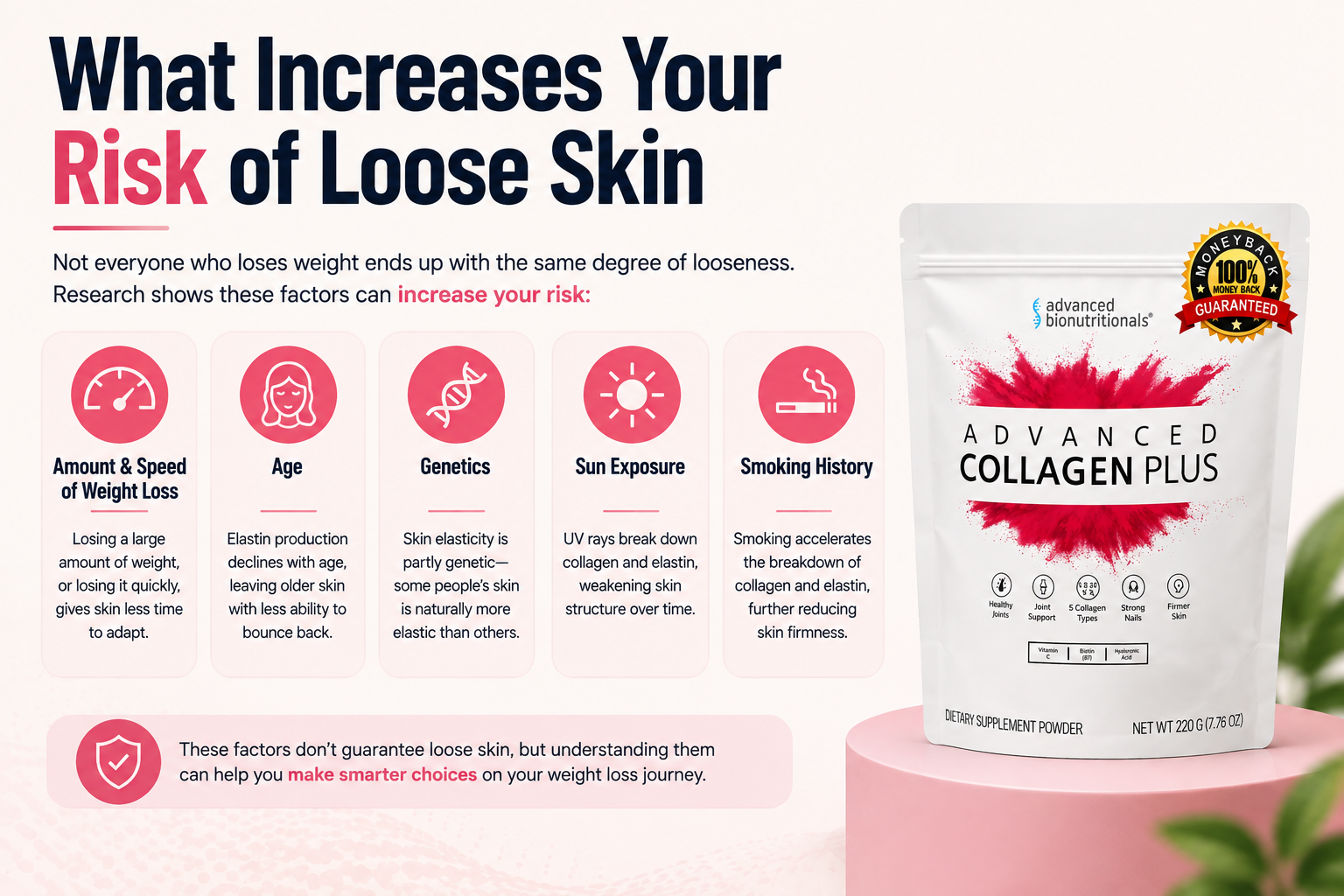
Not everyone who loses weight ends up with the same degree of looseness. A few factors consistently show up in the research on factors linked to skin laxity severity, a study assessing skin laxity in female patients' lower-body skin (thighs, buttocks, and knees), which found that severity correlates with age, BMI, total weight, sun exposure, and cellulite severity:
- Amount and speed of weight loss. Losing a large amount of weight, or losing it quickly, gives skin less time to gradually adapt. A comparison of surgical (bariatric) versus non-surgical weight loss found that the surgical group, which tends to lose weight faster and in greater amounts, showed a significantly greater reduction in elastic fiber content in abdominal skin than the non-surgical group, even though collagen content dropped similarly in both groups.
- Age. Elastin production declines after physical maturity, and existing elastic fibers gradually degrade with age. Older skin simply has less structural reserve to draw on when it's stretched and then needs to retract.
- Genetics. Some people's skin is inherently more elastic than others, independent of weight history, which is why two people who lose similar amounts of weight can end up with very different amounts of looseness.
- Sun exposure and smoking history. Both accelerate the breakdown of collagen and elastin over time, compounding whatever effect weight change has on skin structure.
Loose Skin After GLP-1 Medications (Ozempic, Wegovy, Mounjaro): Is It Different?
GLP-1 receptor agonists like semaglutide and tirzepatide have changed how quickly and how much weight some people lose. In the STEP 1 trial, once-weekly semaglutide produced an average 14.9% body-weight reduction over 68 weeks, compared to 2.4% with placebo, with 86% of participants losing at least 5% of their body weight. Follow-up data from the STEP 5 trial showed that effect held up over two years, with a 15.2% average reduction sustained at 104 weeks. That's meaningfully faster and larger than what most people achieve through diet and exercise alone in the same timeframe.
Speed and magnitude matter here because subcutaneous fat acts as scaffolding that supports skin from below. When that fat is lost quickly, the skin can be left without adequate structural support before it has time to gradually contract, which is part of why "semaglutide face" has become a recognized, if informal, term in aesthetic medicine. A review in the esthetic-medicine literature on how GLP-1-driven weight loss affects skin describes this as a multimodal problem best addressed with a combination of approaches (topical and procedural), not a single fix.
This reflects well-informed clinical consensus from experts in the field, though it's worth being precise about its limits: it's a synthesis of expert and clinical opinion, not a controlled trial isolating GLP-1 medications' independent effect on skin from weight-loss speed and amount generally. If you're on a GLP-1 medication and concerned about skin laxity, a more gradual dose titration is a reasonable thing to discuss with your prescriber, though it isn't a guaranteed prevention method.
Does Loose Skin After Weight Loss Go Away on Its Own? (Realistic Timeline)
Simple timeline graphic titled "Skin Remodeling After Weight Loss: Weeks to 24 Months," showing early hydration-related changes in the first few weeks versus longer-term collagen and elastin remodeling extending to 24 months. Alt text: Timeline graphic showing skin tightening progress from a few weeks to 24 months after weight loss.
What Happens in the First Few Weeks vs. the First Two Years
In the first few weeks after reaching a stable weight, any visible change tends to come from shifts in hydration and minor swelling resolving, not true structural remodeling. Real collagen and elastin remodeling is a slower process. Plastic surgeons and body-contouring specialists commonly observe that mild-to-moderate skin looseness, generally in the range of 20 to 50 pounds lost, tends to improve over roughly 6 to 24 months as the skin gradually remodels. Plastic surgeons and specialists arrived at that window through consistent practitioner experience rather than one definitive controlled study, and because the professional guidance agrees on it across the board, patience matters here as much as any specific intervention.
When Loose Skin Is More Likely to Be Permanent
Not all loose skin resolves. If you've lost a large amount of weight (particularly more than 50-100 pounds), are older, have a strong sun exposure or smoking history, or simply have skin that was already less elastic to begin with, some degree of looseness may not fully retract no matter how much time passes. Most practitioners consider surgical consultation a realistic option once skin has failed to visibly improve after 12 to 18 months at a stable weight and is causing physical discomfort (like chafing or skin infections in folds) or a meaningful quality-of-life impact. The general recommendation is to wait until your weight has been stable for at least 6 to 12 months before pursuing body-contouring surgery, since further weight change afterward can undo the results.
Evidence-Based Ways to Tighten Loose Skin Naturally
The good news is that you're not limited to waiting and hoping. Several approaches have real evidence behind them, even if none of them is a guaranteed fix for every case.
Strength Training to Build Lean Muscle Under the Skin
Building muscle underneath loose skin can improve its appearance by filling out the area the skin is draped over, even when the skin itself hasn't fully tightened. There's a physiological reason strength training matters during weight loss specifically: research on resistance training and body composition during weight loss shows that roughly 20 to 30% of the weight lost through calorie restriction alone tends to be lean tissue rather than fat, and that resistance training is more effective than no training at preserving or building that lean mass during a weight loss period.
A practical approach is to prioritize compound resistance exercises (squats, rows, presses) two to four times a week, focusing on the areas where you're noticing the most looseness, such as the midsection, arms, or thighs. The "muscle fills the space" effect is a reasonable and widely observed physiological mechanism worth building your routine around, though it's worth being clear that the underlying research tracks muscle and body-composition outcomes, not skin laxity directly, so it won't reverse skin damage on its own.
Hydration and Its Role in Skin Elasticity
Well-hydrated skin has more turgor, meaning it holds its shape better under normal tension, which is part of why skin can look temporarily tighter or more supple within days of improving hydration and look more deflated during dehydration. As a general rule of thumb, consistent daily water intake supports the skin's baseline elasticity, though hydration alone won't rebuild damaged collagen or elastin fibers. Think of it as maintaining the conditions skin needs to function well, not a stand-alone treatment for established looseness.
Protein Intake as a Building Block for Skin Repair
Collagen itself is a protein, so adequate dietary protein gives your body the raw material it needs for any tissue repair, skin included. Research on protein intake and lean body mass during weight loss found that higher intake, in the range of 1.2 to 1.6 grams per kilogram of body weight per day, better preserves lean mass and improves body composition compared to standard intake around 0.8 grams per kilogram, and that intake below roughly 1.0 gram per kilogram per day is associated with greater lean-mass decline during weight loss.
Adequate protein supports the general biological process of tissue repair rather than acting as a targeted skin-tightening intervention; the studies behind that conclusion measured lean-mass preservation, not whether a specific protein target reverses skin laxity directly. A practical approach many people find useful is prioritizing a protein source at each meal (eggs, poultry, fish, legumes, dairy, or a protein supplement) rather than trying to hit an exact gram target every day.
Collagen Supplementation: What the Evidence Actually Says
This is the area where it's easiest to overstate what the research shows, so it's worth being precise. A 12-week clinical trial on collagen peptides and skin elasticity, randomized, double-blind, and placebo-controlled, gave 64 women aged 40 to 60 a daily 1,000 mg dose of a low-molecular-weight, fish-derived collagen peptide and found significantly improved skin hydration at both 6 and 12 weeks, along with improvement in two of three measured elasticity parameters and three of five wrinkling parameters compared to placebo, with no adverse events reported. A broader systematic review and meta-analysis of randomized controlled trials on oral collagen supplementation reached a similar directional conclusion: statistically significant improvements in skin hydration and elasticity versus placebo across pooled trials.
It matters to be upfront about what this evidence base doesn't cover: these trials measured general skin hydration, elasticity, and wrinkling in adult women. None enrolled people who had already lost significant weight and developed loose skin, so none directly tested whether collagen reverses established post-weight-loss skin laxity.
So the accurate statement is that collagen supplementation has real, research-supported benefits for general skin hydration and elasticity, and it's a reasonable, low-risk addition to a broader plan. It is not a demonstrated fix for already-loose skin on its own, and any product or article claiming otherwise is overstating the evidence. Framed that way, collagen for loose skin after weight loss is worth considering as one part of a realistic plan, not a stand-alone solution.
Two supporting nutrients come up often alongside collagen: vitamin C, which is a required cofactor for the body's own collagen synthesis, and biotin, which supports keratin production in skin, hair, and nails. Chondroitin sulfate, a component of skin's connective tissue, is also frequently included in collagen formulas because it supports the extracellular matrix collagen sits within.
How to Tell If a Collagen Supplement Is Actually High Quality
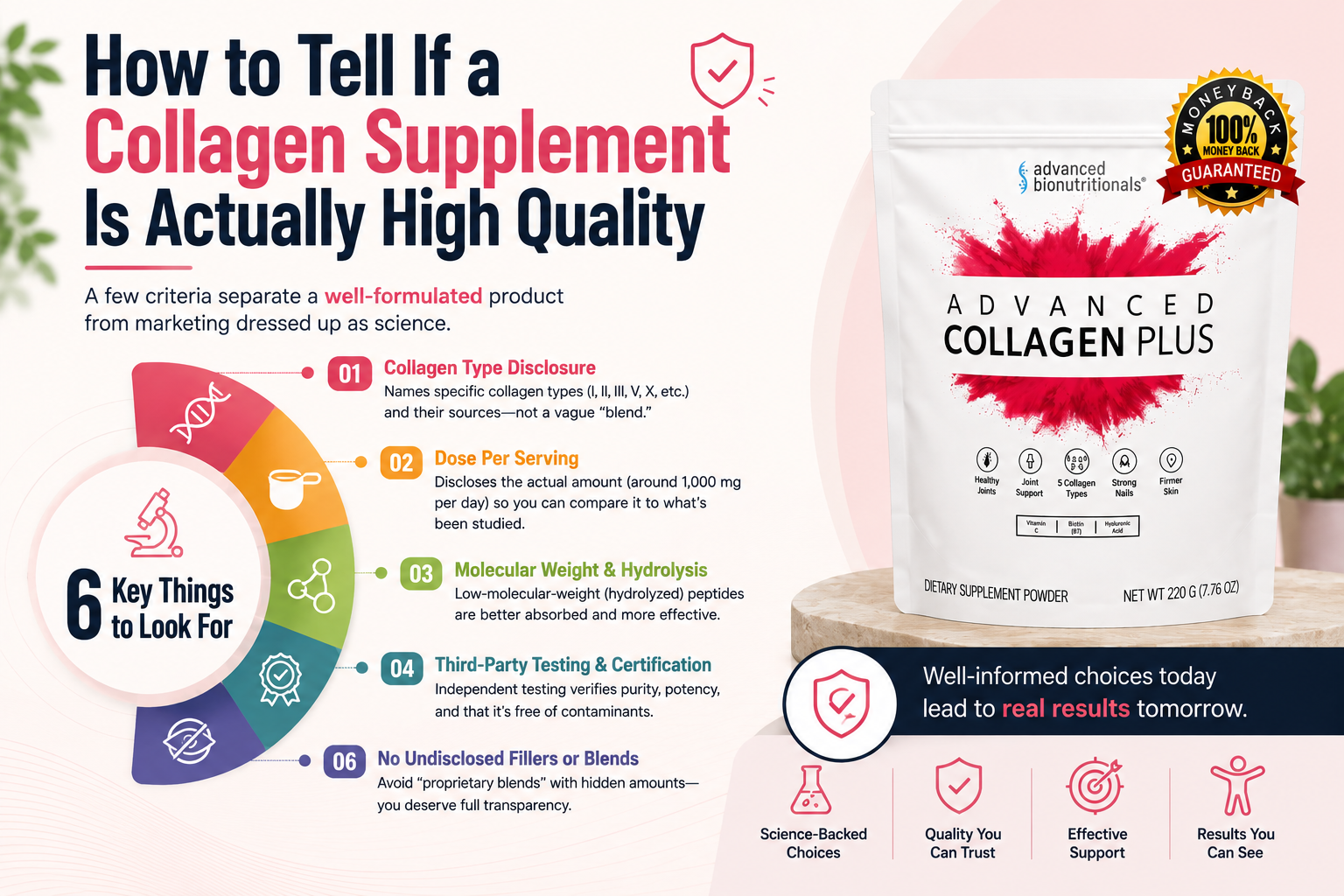
Once you decide collagen supplementation is worth trying, the market makes it genuinely hard to tell a well-formulated product from marketing dressed up as science, and even harder to identify the best collagen supplement for weight-loss support versus one that just has good marketing. A few criteria separate the two:
- Collagen type disclosure. Skin, joints, and connective tissue are built from different collagen types (I, II, III, V, and X, among others). A quality product names which types it contains and where they come from, rather than listing a vague "collagen blend."
- Dose per serving. The clinical research showing hydration and elasticity benefits used doses around 1,000 mg per day of a specific peptide. A product that discloses its actual per-serving dose lets you compare it to what's actually been studied; one that hides behind a "proprietary blend" doesn't.
- Molecular weight and hydrolysis. Collagen has to be broken down (hydrolyzed) into smaller peptides, measured in Daltons, to be absorbed effectively. Lower molecular weight generally means better bioavailability, which is part of why the RCT showing measurable hydration and elasticity benefits specifically used a low-molecular-weight peptide.
- Third-party testing and certification. Independent testing verifies that what's on the label is actually in the product, and that it's free of contaminants. This is one of the simplest ways to separate a serious supplement company from one relying on marketing alone.
- No undisclosed fillers or proprietary blends. If a label lists a "proprietary blend" without individual amounts, you have no way to know if you're getting a clinically relevant dose of anything.
- A simple at-home check. A genuinely well-hydrolyzed, high-quality collagen powder should dissolve fully and mix smoothly into hot or cold liquid without excessive clumping or grittiness. This isn't a scientific test, but a product that mixes poorly is a reasonable prompt to double-check the manufacturing quality behind it.
[VISUAL PLACEHOLDER: Collagen Supplement Quality Checklist table with five criteria: collagen type disclosed, dose per serving disclosed, molecular weight/hydrolyzation stated, third-party testing/certification present, no undisclosed proprietary blends or fillers. Alt text: Checklist table showing five criteria for evaluating collagen supplement quality.]
This article contains an affiliate link. If you buy through it, Slim Glow Dr may earn a commission at no extra cost to you.
One product that meets these criteria is Advanced Collagen Plus from Advanced Bionutritionals. It's formulated with five collagen types from four disclosed sources, Types I and III from grass-fed bovine collagen, Type II from pasture-raised chicken, Type V from wild-caught marine sources, and Type X from organic eggshell membrane, along with biotin and chondroitin sulfate. It's designed to be flavorless and mixable in hot or cold liquid, and it comes with a 90-day money-back guarantee.
To be clear about what this recommendation is and isn't: it's an example of a supplement that discloses the specifics this section just taught you to look for, not a claim that it (or any collagen supplement) will reverse established loose skin. As with any collagen product, expect it to support general skin hydration and elasticity as part of a broader plan, and know that individual results vary. If you're on medication, pregnant, or managing a health condition, check with your doctor before adding any new supplement.
See the collagen supplement that discloses everything on this checklist
Advanced Collagen Plus lists its collagen types, sources, and per-serving dose instead of hiding behind a "proprietary blend," and it's backed by a 90-day money-back guarantee.
Check Advanced Collagen Plus Here
Disclosed affiliate link — Slim Glow Dr may earn a commission at no extra cost to you.
When Natural Methods Aren't Enough: Non-Surgical and Surgical Options
If time, strength training, hydration, protein, and collagen supplementation haven't meaningfully improved your skin after a reasonable window, and it's affecting your comfort or confidence, medical options exist. None of the following is a personal recommendation, and all of them should be discussed with a qualified provider who can evaluate your specific situation.
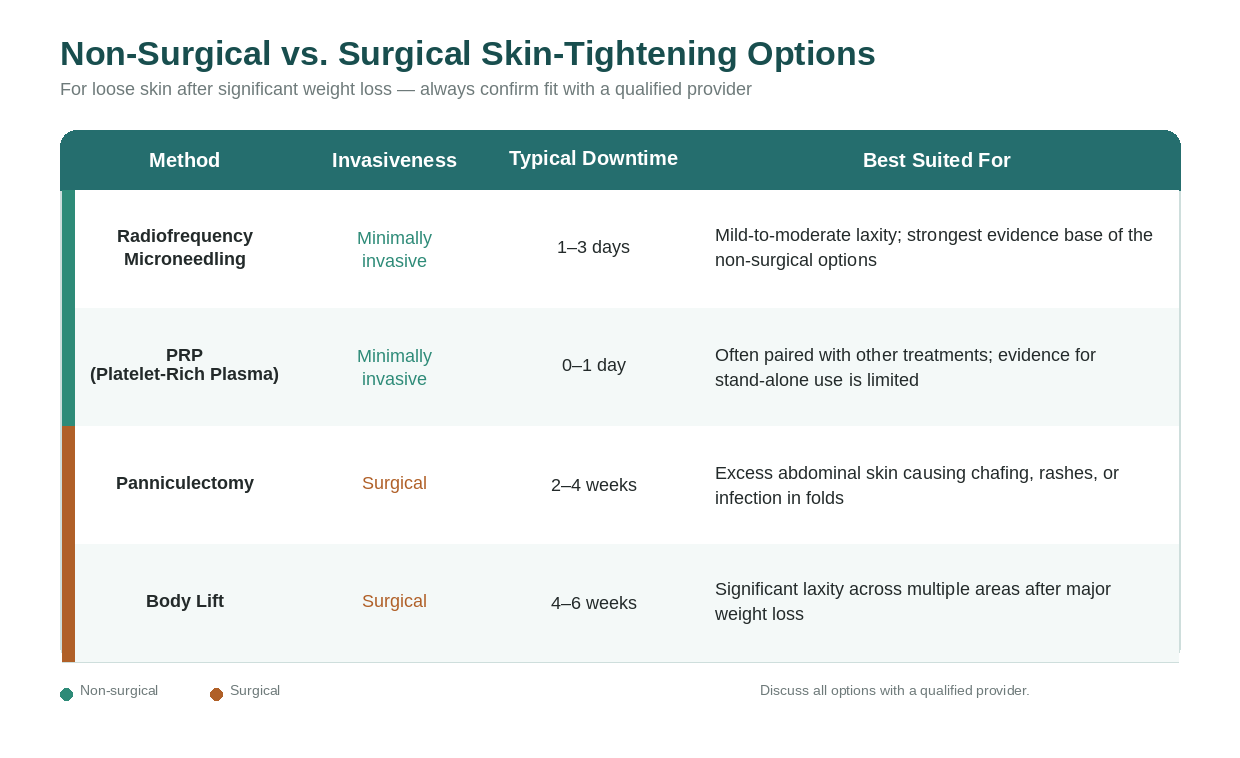
Non-Surgical Skin-Tightening Options (Radiofrequency, Microneedling, PRP)
Radiofrequency microneedling works by using heat to trigger controlled collagen contraction and stimulate new collagen production (neocollagenesis) over the following months. A systematic review of radiofrequency microneedling covering 20 studies and 558 participants found a favorable safety profile, with only mild, transient side effects and no serious complications reported, and patient satisfaction exceeding 90% in most included studies. Most of this evidence comes from facial and cosmetic contexts rather than body skin specifically after major weight loss, so results on areas like the abdomen or arms may vary from what's been studied on the face.
Platelet-rich plasma (PRP) is sometimes combined with these treatments, but the evidence specifically supporting PRP for skin tightening is considerably thinner than the evidence for radiofrequency microneedling, so it's worth treating PRP as a more speculative add-on rather than a proven standalone option. A qualified dermatologist or plastic surgeon can walk you through which non-surgical option, if any, fits your degree of laxity and the area affected.
Surgical Options (Panniculectomy, Body Lift)
For skin laxity severe enough to cause chronic irritation, skin infections in folds, or significant functional limitation, surgical procedures like a panniculectomy (removal of excess abdominal skin) or a full body lift (addressing multiple areas at once) can achieve results that no non-surgical option can match. These are real surgeries with real recovery times and risks, and they're generally recommended only after weight has been stable for 6 to 12 months. If you're considering this route, a consultation with a board-certified plastic surgeon is the appropriate next step, not a decision to make from an article.
The Bottom Line
Loose skin after weight loss is a normal, explainable consequence of significant weight change, not evidence that your effort failed or that something is wrong with you. Your skin's collagen and elastin simply need time, and often support, to catch up with the new shape underneath. Starting with free, evidence-based habits—strength training, hydration, and adequate protein—gives your skin the best foundation, and a well-formulated collagen supplement can be a reasonable addition on top of that foundation, with realistic expectations about what it can and can't do. Give the 12-to-24-month remodeling window real patience while you take these steps, and know that non-surgical and surgical options remain available if your skin doesn't resolve on its own.
If you're not ready to consider a supplement yet, that's a completely reasonable place to start: focus first on the strength training and nutrition habits covered above, and check back on our Natural Remedies hub for more Slim Glow Dr guides on building those foundations.
Individual results vary. This article is educational and does not constitute medical advice; consult a qualified healthcare provider before starting any new supplement or considering a medical procedure for skin laxity.
Give your skin an evidence-based head start while it remodels
You've already done the hard part. Advanced Collagen Plus discloses its collagen types, sources, and dose, and comes with a 90-day money-back guarantee, so there's no risk in trying it alongside the strength training and protein habits above.
Try Advanced Collagen Plus Risk-Free Here
Disclosed affiliate link — Slim Glow Dr may earn a commission at no extra cost to you.
Frequently Asked Questions
Does loose skin after weight loss go away on its own?
For mild-to-moderate looseness, yes, it often improves on its own over 6 to 24 months as collagen and elastin gradually remodel, especially if you support that process with strength training, protein, and hydration. More severe cases, particularly after very large or very rapid weight loss, may not fully resolve without additional support or medical treatment.
How long does it take for loose skin to tighten after weight loss?
Most of the visible improvement happens gradually between 6 and 24 months after your weight stabilizes, according to general clinical observation from plastic surgeons and body-contouring specialists. Early changes in the first few weeks are usually related to hydration, not true structural remodeling.
Can collagen supplements really tighten loose skin?
Collagen supplements have research support for improving general skin hydration and elasticity, but there's no direct clinical evidence that they reverse already-established loose skin after major weight loss specifically. They're reasonable to try as part of a broader plan, not as a stand-alone fix.
Does losing weight quickly on Ozempic, Wegovy, or Mounjaro cause more lose skin?
Rapid, large weight loss from GLP-1 medications can increase loose-skin risk because subcutaneous fat, which supports skin from below, is lost faster than the skin can adapt. Aesthetic-medicine literature recognizes this mechanism, though no controlled trial has isolated it from weight-loss speed and amount generally.
How much weight loss causes loose skin?
There's no fixed threshold, but risk increases with the total amount lost and how quickly it's lost, alongside factors like age, genetics, and sun exposure or smoking history. Plastic surgeons commonly note that even moderate losses in the 20-to-50-pound range can produce noticeable looseness in some people.
Can exercise alone get rid of loose skin?
Exercise, particularly strength training, can improve the appearance of loose skin by building muscle underneath it, but it doesn't directly repair damaged collagen or elastin fibers. It's a genuinely useful part of a plan, not a complete solution on its own.
Is loose skin after weight loss ever permanent?
Yes, in more severe cases, especially with very large weight loss, older age, extensive sun damage, or a smoking history, some degree of skin laxity may not fully resolve regardless of time or non-surgical treatment. That's when a conversation with a plastic surgeon about surgical options becomes a realistic next step.
How do I know if a collagen supplement is actually good quality?
Look for disclosed collagen types and sources, a stated dose per serving, information about molecular weight or hydrolyzation, third-party testing or certification, and no vague "proprietary blends" hiding the actual ingredient amounts. A product that discloses all of this gives you a real basis for comparison instead of relying on marketing language alone.