
If you landed here after seeing an ad, a social post, or an affiliate link for "The Encyclopedia of Power Foods" and you're now wondering whether it's actually worth your money, you're asking the right question before you spend it. This review is a disclosed affiliate review, consistent with FTC disclosure guidelines: Slim Glow Dr may earn a commission if you purchase through the link in this article, at no extra cost to you. That relationship doesn't change what follows. We checked the product's own official pages, cross-referenced the claims circulating about it online, and weighed its central health framework against mainstream nutrition evidence, so you get a straight answer instead of recycled marketing copy.
The short version: the Encyclopedia of Power Foods is a real, purchasable digital nutrition guide. It is not a scam in any meaningful sense of that word. But it's also not a clinically proven weight-loss protocol, and it's easy to confuse with a completely different, unrelated book that happens to share almost the same title. This review separates what's actually confirmed from what's just marketing noise, including the specific stats you may have seen elsewhere that we could not verify.
Quick Answer
The Encyclopedia of Power Foods is a legitimate digital nutrition guide sold through Digistore24 by "365 Daily Health." It organizes foods according to Traditional Chinese Medicine's five-element theory (Wood, Fire, Earth, Metal, Water) and their traditional organ correlations. It's a real product with a working 30-day refund policy, not a scam, but its five-element framework is a traditional/folk-medicine lens rather than a clinically validated weight-loss method. If you're drawn to holistic, food-as-medicine approaches to eating, it's worth a look; if you're expecting a clinically backed weight-loss program, it isn't that.
What Is the Encyclopedia of Power Foods?
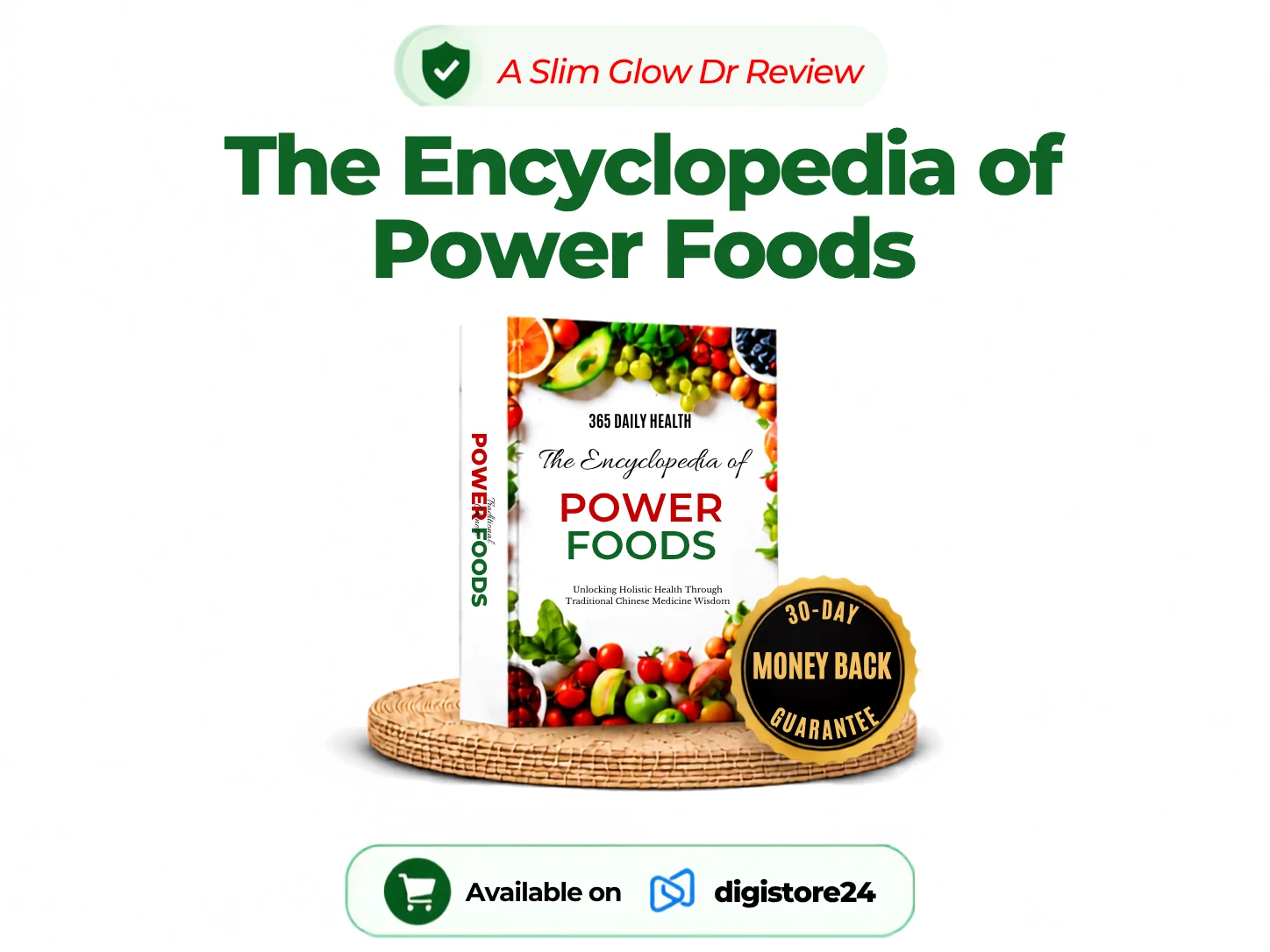
The Encyclopedia of Power Foods is a digital (PDF) guide sold through the "365 Daily Health" sales funnel on Digistore24. According to the official sales page, it "blends Traditional Chinese Medicine with modern nutritional science," organizing foods by their traditional element and organ associations rather than by calories, macros, or glycemic index the way a conventional diet book might.
The guide is built around TCM's five-element theory: Wood, Fire, Earth, Metal, and Water. Each element is traditionally linked to specific organ systems, and foods are grouped by which element they're believed to support. The seller states the guide runs to roughly 375 pages and covers more than 300 individual "power foods," along with a recipes component. That page count and food count come directly from the vendor's own official pages (it's stated identically on both the sales page and the affiliate-recruitment page), which is a meaningfully stronger signal than a single third-party blog repeating a number. Still, it's a self-reported figure for a digital product; there's no independent, non-vendor audit of the actual page count or content depth, so treat it as "what the seller states," not an independently verified fact.
The guide is delivered digitally, meaning there's no physical shipment. You purchase, and access is provided through the checkout platform, typically as a downloadable file or member login rather than something mailed to your door.
Who Created It? (Kenny and Wen Li)
The official sales page attributes the Encyclopedia of Power Foods to Kenny and Wen Li, described as the founders of 365 Daily Health. The page also credits a narrator or co-presenter named Connor Kennedy and includes a foreword from an unverified contributor described on the sales page as "Dr. Ling Zhao, a TCM expert," a credential we could not independently confirm.
Here's the important caveat: all three names come from the seller's own sales page, not from an independent professional bio, license record, or third-party profile we could locate. That doesn't mean the claim is false; it simply means it hasn't been independently corroborated the way you'd want for, say, a medical credential. If a verified professional bio for Dr. Ling Zhao or a licensing record for the stated credentials matters to your purchase decision, that's a reasonable thing to look for and confirm directly with the seller before buying, since we could not independently verify it ourselves.
What's Inside: The Traditional Chinese Medicine Five-Element Food Framework
The organizing idea behind the entire guide is TCM's five-element theory, a centuries-old branch of Traditional Chinese Medicine sometimes called food therapy or Shiliao. In this system, foods are traditionally classified by their properties and correlated with the body's organ systems, with the stated goal of supporting balance rather than simply counting nutrients. It's a good example of the broader holistic approaches to nutrition that sit outside mainstream clinical dietetics, which is an important distinction to keep in mind as you read through what the guide actually contains.
The Five Elements and Their Organ-Food Correlations (Wood, Fire, Earth, Metal, Water)
The guide's exact internal food lists aren't reproduced here, since we're reviewing the product rather than reprinting its proprietary content, but the table below offers a general five elements diet food list reflecting the traditional classification system the guide is built on, as documented in TCM food therapy literature.
| Element | Traditionally Associated Organs | Representative Food Categories |
| Wood | Liver, Gallbladder | Leafy greens, sprouted foods, sour fruits |
| Fire | Heart, Small Intestine | Bitter greens, tomatoes, red-hued vegetables |
| Earth | Spleen, Stomach | Root vegetables, squash, whole grains |
| Metal | Lungs, Large Intestine | White vegetables, pears, alliums (garlic, onion) |
| Water | Kidneys, Bladder | Legumes, seaweed, dark-hued foods |
This isn't a mechanism mainstream nutrition science has validated; it's how the traditional framework categorizes food. Whether a specific food "supports" a specific organ in the way TCM describes is a belief system claim, not a laboratory finding, and the guide should be read with that distinction in mind.
Food Color Theory and How the Guide Categorizes Foods
Alongside the five-element and organ correlations, TCM food therapy traditionally uses food color as a secondary classification layer: green foods aligning with Wood, red with Fire, yellow with Earth, white with Metal, and black or dark-hued foods with Water. According to the sales page, the guide applies this color-based sorting to help readers quickly identify which foods fall under which element without memorizing organ theory from scratch.
Practically, this means the guide likely functions less like a calorie-counting meal plan and more like a reference system: you'd look up a food or a health goal and see which element and organ family it's traditionally associated with, then choose recipes accordingly. If you're the kind of person who finds rigid macro tracking exhausting, a categorization system like this can feel more intuitive, even though "intuitive" and "clinically validated" are two different things worth keeping separate in your head.
Format, Delivery, and What You Actually Get (PDF/Digital Access, Recipes, Any Bonuses)
Per the official sales page, purchasing gives you digital access to the main guide (stated at approximately 375 pages) plus a recipes component built around the five-element categories. The delivery model is standard for a Digistore24 digital product: you complete checkout, then receive access instructions (typically a download link or account login) rather than a physical book.
One thing worth flagging before you check out: the vendor's own affiliate-recruitment page lists several upsell products offered after the initial purchase, including a "Meridian Healing Frequency Bundle" (roughly $97), a "LUMI+ Hydrogen Water Bottle" ($267 to $696), and a "LUMI+ Hydrogen Mister" ($127 to $234). None of these are required to access the core guide, but they are part of the same checkout funnel, and the full funnel with upsells can run from roughly $528 to $1,064 if you say yes to everything offered. Knowing that up front means the $37 headline price isn't a surprise-free ceiling; it's the front-end offer.
If the five-element framework and recipe library sound like the kind of structure you'd actually use, you can check current pricing and availability for The Encyclopedia of Power Foods directly through the official page. This article contains a disclosed affiliate link; Slim Glow Dr may earn a commission if you purchase through it, at no extra cost to you.
Is the Encyclopedia of Power Foods Legit or a Scam?
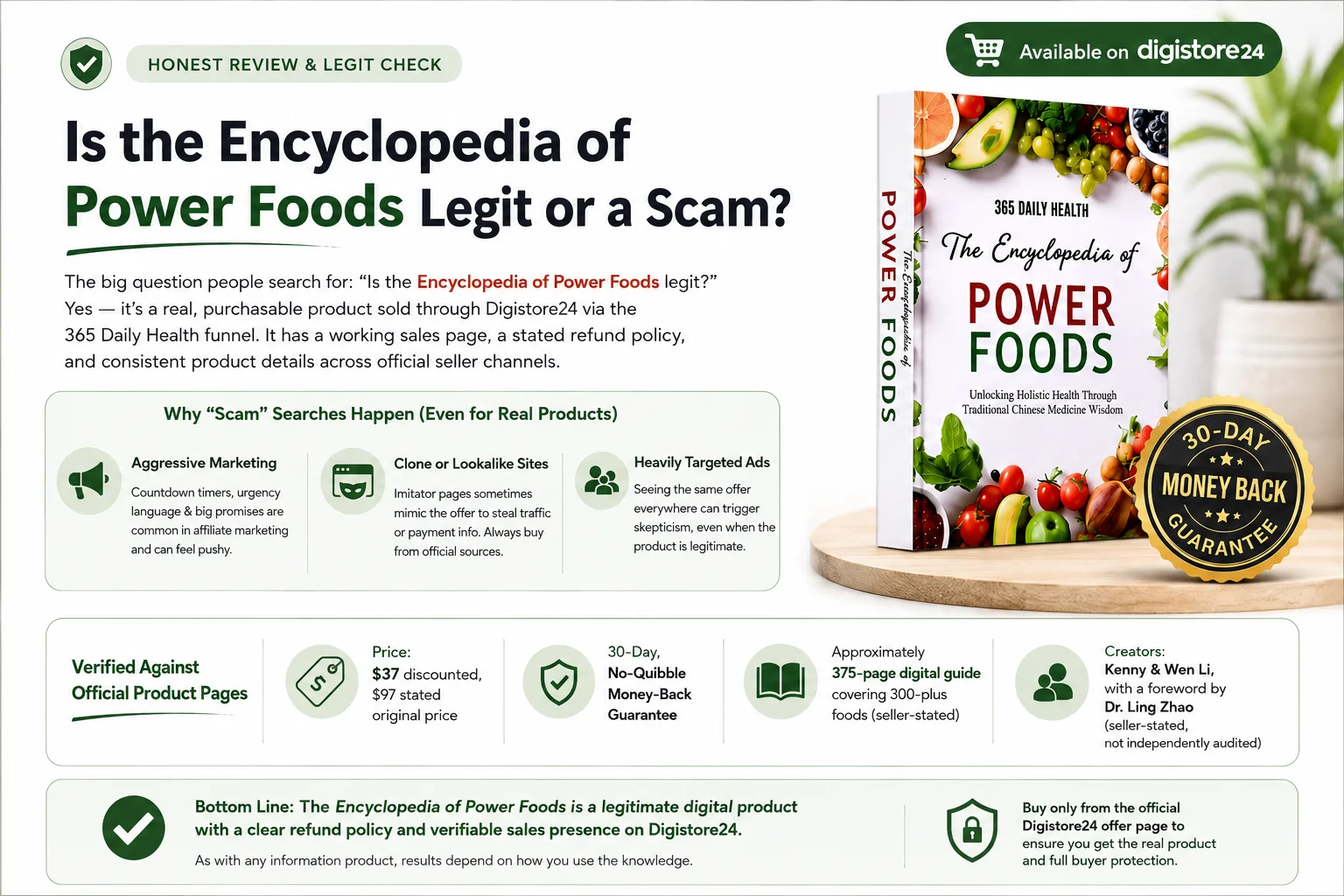
This is usually the real question behind "review" and "legit" searches, so let's answer it directly: the Encyclopedia of Power Foods is a real, purchasable product sold through Digistore24 via the "365 Daily Health" funnel. It has a working sales page, a stated refund policy, and consistent product descriptions across the seller's own official channels. That's a legitimate digital-product operation, not a vanishing scam site.
So why do "is it a scam" searches happen at all for a product like this? A few reasons, and none of them are unique to this guide. Templated, high-pressure marketing copy (countdown timers, urgency language, testimonial callouts) is common across the affiliate-marketing space and tends to make any product feel less trustworthy even when the underlying offer is real. Clone or lookalike sites sometimes appear around popular Digistore24 offers, mimicking the branding to redirect traffic or capture payment details illegitimately. And aggressive ad targeting on social platforms can make a product feel like it's "everywhere," which triggers skepticism whether or not the product itself is sound.
Verified against the official product pages:
- Price: $37 discounted, $97 stated original price
- 30-day, no-quibble money-back guarantee
- Approximately 375-page digital guide covering 300-plus foods (seller-stated)
- Creators named as Kenny and Wen Li, with a foreword attributed to Dr. Ling Zhao (seller-stated, not independently audited)
Could not be verified, and are omitted or flagged here rather than repeated as fact:
- The "4.72/5 stars" and "2,500+ reviews" figures that circulate across several third-party review sites. These numbers do not appear anywhere on either official page we checked (the sales page or the affiliate-recruitment page). Because they show up worded identically across multiple unrelated affiliate blogs, that's a strong sign of copy-paste marketing content rather than an audited rating, so we're not repeating them here.
- A Digistore24 marketplace-level popularity score or cancellation/refund-rate percentage. We couldn't locate a live marketplace listing for this specific product to pull that data from.
None of this points to fraud. It points to a real product wrapped in the kind of loosely sourced marketing language that's common in this niche, which is exactly the gap this review is trying to close. If you decide to buy, purchase only through the verified official link rather than a search-result ad or a site you don't recognize, a topic we'll return to below.
Does It Actually Help With Weight Loss? An Evidence-Based Look
This is the question that matters most if you're specifically weighing power foods for weight loss as your actual goal, and it deserves a careful, honest answer rather than a marketing one.
Traditional Chinese Medicine's five-element and organ-correlation food theory is a genuinely old and culturally significant framework, sometimes called food therapy or Shiliao, used for classifying and thinking about food for centuries. That's a real, documented tradition, not something invented for this product. But being centuries-old and being clinically validated for weight loss are two separate claims. The National Center for Complementary and Integrative Health (NCCIH), a division of the NIH, notes that for TCM-related products more broadly, many supporting studies have been of poor quality, meaning firm conclusions about effectiveness can't be drawn, and it flags additional safety considerations like contamination or undeclared ingredients in some herbal products specifically. NCCIH's guidance doesn't evaluate this exact five-element food framework, but it's directly relevant context on how much clinical evidence generally exists behind TCM-branded health claims.
Here's the more useful, practical point for anyone actually trying to lose weight: many of the foods a guide like this would categorize as "power foods," vegetables, lean proteins, legumes, whole grains, overlap substantially with the food groups mainstream nutrition science already supports for weight management and satiety, independent of any TCM framing at all. Peer-reviewed research on dietary patterns for weight management consistently associates diets higher in vegetables, fruit, whole grains, lean protein, and legumes, and lower in processed and added-sugar foods, with better weight and metabolic outcomes.
Put plainly: if you follow this guide's food recommendations and see any benefit, the most defensible explanation is the nutritional properties of the actual foods involved (fiber, protein, micronutrient density, lower processed-food intake), not the five-element or organ-correlation mechanism itself, which hasn't been clinically validated as a weight-loss protocol. That's not a knock on the tradition. It's simply the honest boundary between "a meaningful cultural framework for thinking about food" and "a clinically proven method for losing weight." If you want a broader look at what actually moves the needle metabolically, our guide to evidence-based approaches to weight loss and metabolism walks through the research in more depth.
If you have an existing health condition, take medication, or are pregnant or breastfeeding, talk to a doctor or registered dietitian before making significant dietary changes based on any food framework, traditional or otherwise.
Not to Be Confused With: The Carlson Wade "Encyclopedia of Power Foods" Book
This is a genuinely important disambiguation, and we're calling it out directly because the naming overlap is a real source of buyer confusion, not a minor footnote.
There is a completely different, unrelated book titled "Encyclopedia of Power Foods for Health and Longer Life" by Carlson Wade, originally published as a 1982 Simon & Schuster paperback (ISBN 9780132761215), with an earlier 1980 Prentice Hall hardcover edition (ISBN 9780132761390). It's independently confirmed as a real, decades-old print book through multiple booksellers, including Biblio, Amazon, and AbeBooks.
That book has no connection to the digital guide reviewed here. Different author, different creator, different decade, different publisher, different format, and a different underlying framework. Carlson Wade's book predates the 365 Daily Health product by roughly four decades and was never sold through Digistore24 or any modern affiliate funnel. If you search for "Encyclopedia of Power Foods" and see used paperback listings on Amazon alongside a modern-looking sales page with a 30-day guarantee and a digital checkout, you're looking at two entirely separate products that happen to share a near-identical title. This review covers only the modern digital guide sold through "365 Daily Health" on Digistore24, not the Carlson Wade book.
Price, Discounts, and Refund Policy
What It Costs (Current Pricing and Any Discount)
The official sales page lists the Encyclopedia of Power Foods at $37, discounted from a stated original price of $97. This figure is confirmed identically on both the official sales page and the seller's separate affiliate-recruitment page, which is a stronger signal than a price quoted on a single third-party site.
Worth knowing before checkout: that $37 is the front-end price. The seller's affiliate materials show a multi-step upsell sequence after the initial purchase, including a Meridian Healing Frequency Bundle, a LUMI+ Hydrogen Water Bottle, and a LUMI+ Hydrogen Mister, which together can bring total potential spend to somewhere between $528 and $1,064 if you accept every offer presented. None of these are required to use the core guide. As a general rule of thumb with any digital-product checkout funnel, it's worth deciding in advance what you actually came to buy and declining upsells that weren't part of your original decision.
Money-Back Guarantee / Refund Policy
The official sales page states a 30-day, "no-quibble" money-back guarantee, with language to the effect of a full refund even if you request it 29 days and 23 hours after purchase. That's the policy confirmed directly on the page reachable from this article's affiliate link, and it's the figure we're standing behind here.
One thing to flag: at least one third-party review source referenced a "60-day guarantee via ClickBank" for this product. That claim doesn't match the 30-day policy stated on the Digistore24-linked sales page used for this review, and we couldn't trace it to an authoritative source, so treat it as unverified and possibly tied to a different or outdated distribution channel. If refund timing matters to your purchase decision, confirm the exact terms at checkout before you buy, since checkout terms can be updated by the seller after this review was written.
Pros and Cons
Pros
- Real, purchasable product with consistent details across its own official pages
- Working 30-day money-back guarantee stated directly on the sales page
- A genuinely distinct, holistic organizing framework (five-element/organ theory) for readers who find calorie-counting demotivating
- Includes a recipes component alongside the reference material
- Digital delivery means immediate access without waiting on shipping
Cons
- The core five-element/organ-correlation mechanism is a traditional framework, not a clinically validated weight-loss method
- Page count, food count, and creator bios are self-reported by the seller, not independently audited
- Star rating and review count circulating online could not be verified and don't appear on either official page
- Checkout funnel includes several upsells that can meaningfully raise total spend beyond the $37 front-end price
- Much of the underlying nutritional guidance (eat more vegetables, lean protein, whole grains) is also available for free through public health resources
Who This Guide Is a Good Fit For
This guide is a reasonable fit if you're specifically drawn to holistic or traditional approaches to eating and want a structured, food-as-categorization system to organize your choices around, rather than macro tracking or calorie counting. It's also a plausible fit if you already enjoy TCM-adjacent wellness content and want a recipe resource built around that lens. If the five-element framework genuinely resonates with how you think about food, the underlying food recommendations (largely vegetables, lean proteins, whole grains) are still nutritionally reasonable even if you set aside the organ-correlation theory entirely.
Who Should Probably Skip It
Skip it if you're specifically looking for a clinically validated, evidence-based weight-loss protocol and would be disappointed to learn the core mechanism is a traditional framework rather than a peer-reviewed method. It's also probably not worth it if you're on a tight budget and would rather use free, mainstream resources (like public dietary guidelines) to build a vegetable-forward, whole-food eating pattern without paying for the five-element framing. And if checkout upsells tend to pull you into spending more than you planned, it's worth going in with a firm budget decided in advance.
How to Buy Safely (and Avoid Clone/Scam Sites)
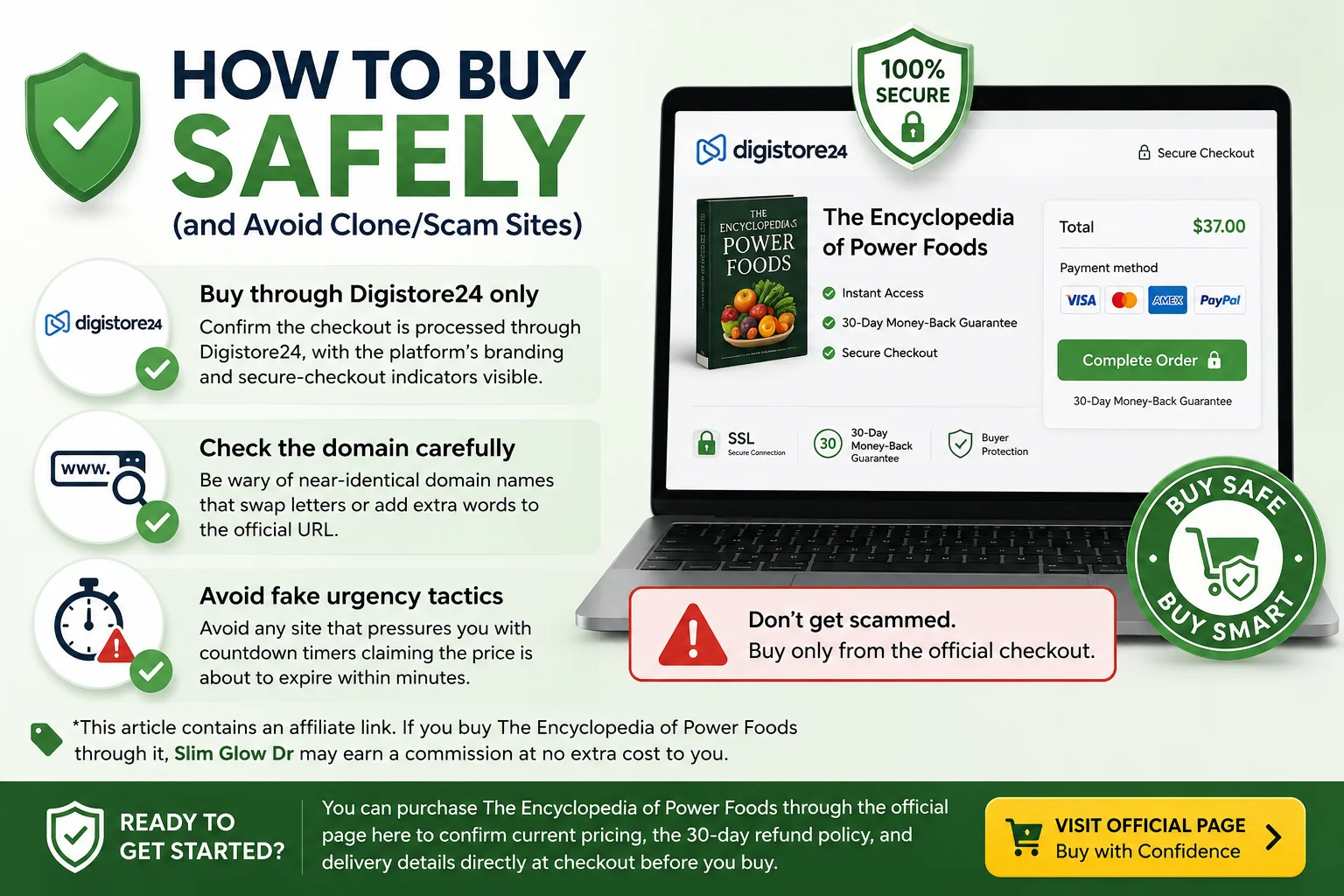
If you've decided the Encyclopedia of Power Foods is worth trying, buy only through the verified official checkout, not through a random search-result ad or a domain you don't recognize. A few practical checks before you hand over payment details:
- Confirm the checkout is processed through Digistore24, with the platform's branding and secure-checkout indicators visible at payment.
- Be wary of near-identical domain names that swap letters or add extra words to the official URL.
- Avoid any site that pressures you with countdown timers claiming the price is about to expire within minutes, a common tactic on clone pages designed to mimic legitimate funnels.
This article contains an affiliate link. If you buy The Encyclopedia of Power Foods through it, Slim Glow Dr may earn a commission at no extra cost to you.
You can purchase The Encyclopedia of Power Foods through the official page here to confirm current pricing, the 30-day refund policy, and delivery details directly at checkout before you buy.
Conclusion
The Encyclopedia of Power Foods is a real, purchasable digital nutrition guide, not a scam, built around Traditional Chinese Medicine's five-element food theory. If you're genuinely drawn to a holistic, food-as-categorization approach to eating and you go in understanding that the five-element and organ-correlation mechanism is a traditional framework rather than a clinically proven weight-loss protocol, it's a reasonable product to consider, provided you confirm the current price, upsell structure, and refund terms directly at checkout. If you're specifically shopping for a clinically validated weight-loss method, this isn't that, and it's worth saying plainly rather than letting the marketing imply otherwise.
One more reminder before you go: this digital guide has nothing to do with Carlson Wade's older, unrelated print book of a nearly identical title. If a search result surfaced that used paperback, you're looking at a different product entirely.
This article contains a disclosed affiliate link; Slim Glow Dr may earn a commission if you purchase through it, at no extra cost to you. If you'd like to compare it against other options before deciding, browse more honest supplement and product reviews on Slim Glow Dr, or check current pricing and the 30-day guarantee on the official Encyclopedia of Power Foods page directly.
Frequently Asked Questions
Is the Encyclopedia of Power Foods legit or a scam?
It's a legitimate, purchasable digital product sold through Digistore24, not a scam. The confusion around "is it a scam" searches mostly comes from generic affiliate-marketing tactics and unverifiable third-party stats circulating around it, not evidence of fraud.
What is inside the Encyclopedia of Power Foods guide?
According to the seller's official pages, it's a roughly 375-page digital guide covering more than 300 foods organized by TCM's five-element theory (Wood, Fire, Earth, Metal, Water) and their traditional organ correlations, plus a recipes component.
Who created the Encyclopedia of Power Foods (Kenny and Wen Li)?
The official sales page credits Kenny and Wen Li, founders of 365 Daily Health, as creators, with a foreword attributed to Dr. Ling Zhao and narration by Connor Kennedy. These attributions come from the seller's own page and haven't been independently verified against outside professional bios.
Does the Encyclopedia of Power Foods actually help with weight loss?
Its five-element and organ-correlation theory is a traditional framework, not a clinically validated weight-loss method. Many of the foods it likely emphasizes (vegetables, lean protein, whole grains) do overlap with food groups mainstream nutrition science supports for weight management, so any benefit is more plausibly tied to those foods' known properties than to the five-element mechanism itself.
What are "power foods" in Traditional Chinese Medicine?
In TCM food therapy, foods are traditionally grouped by their associated element and organ system rather than by calories or macros, with the goal of supporting overall balance according to that tradition. It's a centuries-old classification system, not a term with a single clinical definition in mainstream nutrition science.
Is there a free PDF download of the Encyclopedia of Power Foods?
No legitimate free copy is confirmed. Downloading a "free" version from an unofficial site risks a low-quality or altered file, and potentially exposes your device or payment details to a scam site unrelated to the actual product.
How much does the Encyclopedia of Power Foods cost, and is there a discount?
The official sales page lists it at $37, discounted from a stated $97. That's the front-end price; the checkout funnel includes optional upsells (a frequency bundle and hydrogen-water products) that can raise total spend to $528 to $1,064 if you accept them.
What is the refund/money-back policy?
The official sales page states a 30-day, no-quibble money-back guarantee. A third-party mention of a "60-day ClickBank guarantee" doesn't match this page's terms and shouldn't be relied on.
Is this the same book as Carlson Wade's "Encyclopedia of Power Foods for Health and Longer Life"?
No. Carlson Wade's book is an unrelated 1982 print title (ISBN 9780132761215) with no connection to this modern digital guide. Different author, different era, different format, different framework.
Where is the only official/safe place to buy it?
Through the verified official Digistore24-linked checkout. Avoid lookalike domains and third-party "free download" sites, which are the most common source of confusion and risk around this product.