

Last updated September 3, 2026
If you've noticed your hands and feet get cold faster than they used to, or you're dragging by mid-afternoon even though nothing in your routine has changed, you're not imagining it. For a lot of women in their 50s, 60s, and 70s, that combination of low energy, occasional brain fog, and a nagging worry about circulation and heart health is exactly what makes it harder to stay consistent with exercise and weight management, even when the motivation is there.
Nitric oxide has become a popular topic in this space, and for good reason: it's a real molecule with a well-documented role in blood flow. But "popular topic" and "proven supplement" are not the same thing, and this article is written to keep those two ideas separate. We'll walk through what nitric oxide actually does, what the research realistically supports (including where it doesn't), and then take an honest look at CircO2, a nitric oxide supplement from Advanced Bionutritionals, evaluated on its ingredients and transparency rather than its ad copy.
Disclosure: This article contains an affiliate link. If you buy CircO2 through the link below, Slim Glow Dr may earn a commission at no extra cost to you. That relationship did not change how we evaluated the evidence.
Quick Answer
There's no single "best" nitric oxide supplement backed by strong, product-specific research, but the ingredient categories with the most consistent scientific support are L-citrulline and dietary nitrates (found in beetroot), which research suggests may support blood flow and vasodilation. Below, we evaluate CircO2, a supplement built around several of these evidence-supported ingredients, as one option for readers who want a convenient, ingredient-transparent choice, alongside honest caveats about what's proven and what's marketing.
What Is Nitric Oxide and Why It Matters for Circulation and Energy
Nitric oxide (NO) is a signaling molecule your body produces in the lining of your blood vessels. It's not something you get from food directly; instead, your body makes it from amino acids like L-arginine, or converts it from dietary nitrates found in foods like beets and leafy greens. Once produced, it acts as a messenger that tells the smooth muscle in your blood vessel walls to relax.
How Nitric Oxide Affects Blood Flow and Vasodilation
That relaxation signal is called vasodilation, and it's the mechanism behind almost everything nitric oxide gets credit for. When blood vessels widen, blood moves more freely, oxygen and nutrients reach your muscles and organs more efficiently, and blood pressure tends to ease. Nitric oxide also plays a broader role in endothelial function, the health of the thin layer of cells lining your blood vessels. Research published by the National Institutes of Health describes nitric oxide as a primary regulator of endothelial function: it inhibits abnormal smooth muscle growth, reduces platelet clumping, and limits inflammatory cell buildup in vessel walls. Impaired nitric oxide availability, often called endothelial dysfunction, is considered an independent risk factor for cardiovascular events and is linked to hypertension, insulin resistance, and diabetes. This is why how nitric oxide supports cardiovascular health has become such a well-established area of vascular research, even though the supplement industry built around it is much newer.
Why Nitric Oxide Naturally Declines With Age
Nitric oxide production isn't fixed. Peer-reviewed research on healthy older adults found that endothelium-dependent vasodilation, a direct measure of how well blood vessels respond to nitric oxide, was reduced by more than 50% in the oldest adults studied compared to younger participants. In plain terms, nitric oxide production declines with age, and that decline is a documented part of normal aging rather than a sign that something has gone wrong.
There's a meaningful exception worth knowing: the same body of research shows physically active older adults maintain higher nitric oxide bioavailability than sedentary peers of the same age. That's one reason this article treats nitric oxide as one piece of a broader picture that includes movement and metabolic health, not a standalone fix. If age-related changes to your metabolism are part of what you're navigating, our guide to supporting your metabolic health as you age covers that territory in more depth.
Do Nitric Oxide Supplements Really Work? What the Evidence Shows
The honest answer is "it depends on which ingredient and which outcome you're asking about." Some individual nitric oxide precursors have solid research behind them. Finished commercial products, CircO2 included, generally have much thinner independent research than their ingredients do, which is an important distinction to hold onto through the rest of this article.
L-Citrulline vs. L-Arginine for Circulation
L-arginine was the original nitric oxide supplement ingredient, since it's the direct amino acid precursor your body converts into nitric oxide. The problem is bioavailability. A large share of oral L-arginine gets broken down by enzymes in the liver and intestines before it ever reaches your bloodstream, a process called first-pass metabolism.
L-citrulline sidesteps this. It's absorbed intact and converted to arginine in the kidneys, which research shows raises plasma arginine levels and supports nitric oxide synthesis more reliably than oral arginine alone. This bioavailability advantage is largely why newer nitric oxide formulations, CircO2 included, lean on citrulline rather than arginine as the primary amino-acid ingredient.
Citrulline's performance research is real but modest. Meta-analyses report small effect sizes for strength and power outcomes (researchers describe these findings as "controversial," with effect sizes around Hedges' g ≈ 0.196-0.20) and more consistent benefits for endurance-related measures like oxygen use during exercise and perceived exertion. Effective doses in trials generally range from 3 grams up to 10-15 grams, and it's worth noting that most participants in this research on L-citrulline and blood flow were younger or athletic populations, not the 50-75+ readers this article is written for. Separately, citrulline has also been shown to improve flow-mediated dilation, a marker of endothelial function, with more pronounced effects in people who already have hypertension, heart failure, or peripheral artery disease than in healthy individuals.
Dietary Nitrates, Beetroot, and Vasodilation Research
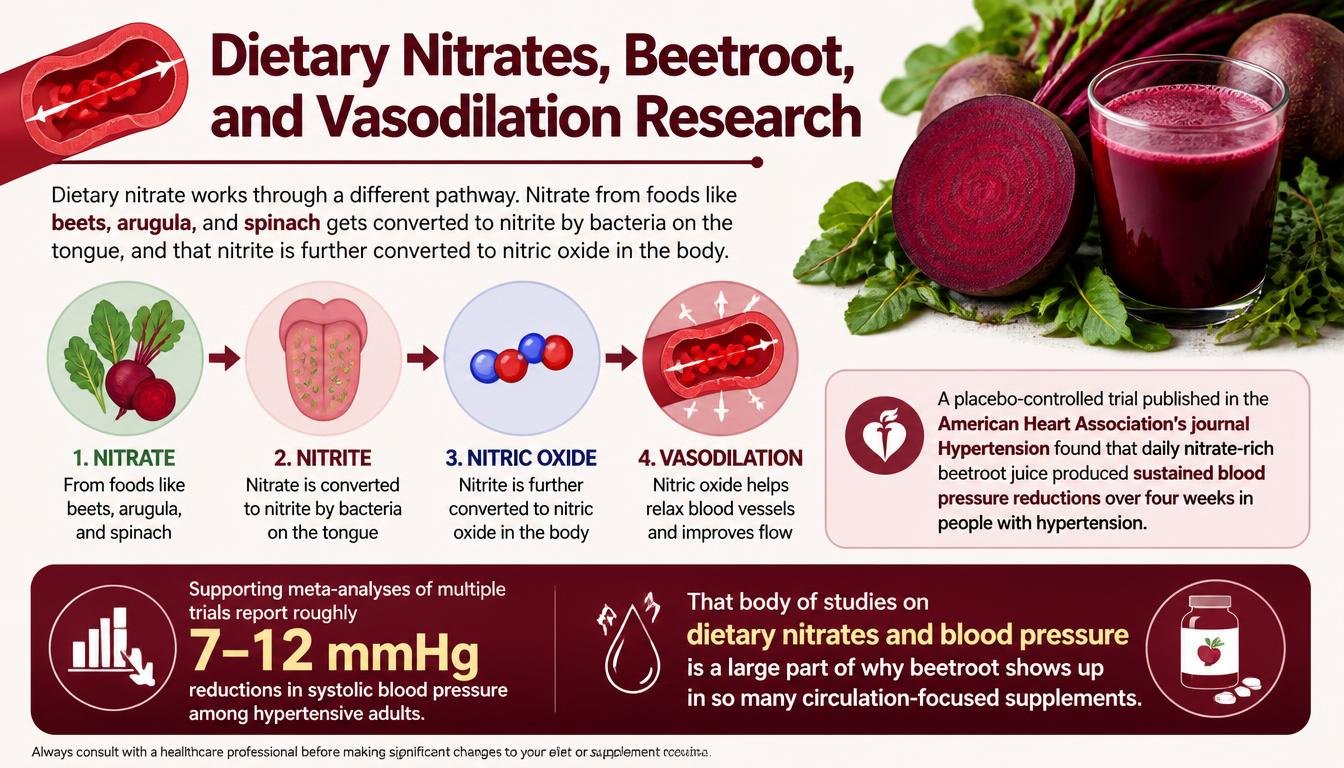
Dietary nitrate works through a different pathway. Nitrate from foods like beets, arugula, and spinach gets converted to nitrite by bacteria on the tongue, and that nitrite is further converted to nitric oxide in the body. A placebo-controlled trial published in the American Heart Association's journal Hypertension found that daily nitrate-rich beetroot juice produced sustained blood pressure reductions over four weeks in people with hypertension, and supporting meta-analyses of multiple trials report roughly 7-12 mmHg reductions in systolic blood pressure among hypertensive adults. That body of studies on dietary nitrates and blood pressure is a large part of why beetroot shows up in so many circulation-focused supplements.
Where the Evidence Is Still Limited
This is the section where a lot of supplement content gets vague, so we want to be specific instead. The positive beetroot findings above come with an important caveat for this article's core audience: a 2024 randomized trial found that four weeks of increased nitrate intake from beetroot juice did not improve vascular function or 24-hour blood pressure in middle-aged and older adults who were already on hypertension medication, even though it confirmed the expected changes in nitrate metabolism. In other words, dietary nitrate's blood-pressure benefit looks fairly consistent in some populations but is meaningfully mixed once you're looking specifically at older adults already managing their blood pressure with medication, which describes a meaningful share of this article's readers. We'd rather tell you that plainly than let a single favorable statistic stand in for the whole picture.
More broadly, most nitric oxide research is built around individual, isolated ingredients tested at specific doses, often in younger or athletic populations. Research on finished multi-ingredient commercial products, tested as a whole, at their actual label doses, in a 50-75+ population, is much rarer. That gap doesn't mean these products don't work; it means the evidence for the underlying ingredients is stronger than the evidence for any single branded formula, CircO2 included.
What to Look for in a Nitric Oxide Supplement (Especially for Seniors)
Given the gap between ingredient-level and product-level evidence, the most useful way to evaluate a nitric oxide supplement is by ingredient quality and transparency rather than by the claims on the box.
Ingredients With the Strongest Research Support
Based on the evidence above, three ingredient categories have the most consistent research behind them: L-citrulline (better absorbed and more reliably converted to nitric oxide than L-arginine), dietary nitrates from beetroot or similar sources (with the caveat that benefit is less clear in older, medicated hypertensive adults), and, to a lesser extent, hawthorn berry, which has vasodilating and endothelial-protective effects shown in several placebo-controlled trials, including a 2003 meta-analysis of 632 patients that found improved exercise capacity and a 2025 meta-analysis of 428 participants that found a 6.65 mmHg reduction in systolic blood pressure. Most hawthorn trials, though, were conducted in people with existing cardiovascular conditions rather than generally healthy adults, and hawthorn carries its own drug-interaction profile, notably with digoxin and blood pressure medications, which is worth knowing before combining it with anything else you take.
| Ingredient | How It Raises Nitric Oxide | Relative Research Strength |
| L-Arginine | Direct amino-acid precursor to nitric oxide | Weakened by first-pass liver/intestinal metabolism; less reliable at raising plasma nitric oxide than citrulline |
| L-Citrulline | Absorbed intact and converted to arginine in the kidneys, bypassing first-pass breakdown | More consistent evidence for raising plasma arginine and supporting nitric oxide synthesis; modest, real benefit for endurance performance and flow-mediated dilation, most pronounced in people with existing vascular conditions |
| Dietary Nitrates (Beetroot) | Converted by oral bacteria to nitrite, then to nitric oxide via the enterosalivary pathway | Solid RCT and meta-analysis support for blood pressure reduction in general hypertensive populations; evidence is mixed specifically in older adults already on blood pressure medication |
Comparison of nitric oxide-boosting ingredients by mechanism and research support.
Safety Considerations for Blood Pressure or Nitrate Medications
In general, the more directly an ingredient raises nitric oxide through the nitrate-nitrite-NO pathway (dietary nitrates, nitrate-based medications), the more relevant it becomes to blood pressure medication interactions, and the more it's worth a conversation with your doctor before starting it. We cover this in detail, including a specific and serious drug interaction, in the Safety section below. If you take blood pressure medication, a nitrate medication, or an erectile dysfunction medication, please read that section before starting any nitric oxide product, CircO2 or otherwise.
CircO2 Nitric Oxide Booster: Ingredients, Claims, and an Honest Evaluation
CircO2 is a fast-dissolving lozenge made by Advanced Bionutritionals, a supplement company based in Norcross, Georgia. It's built around several of the exact ingredient categories the research above identifies as having real, if not always product-specific, support. Here's what's actually in it, what the company claims about it, and who it realistically fits.
What's in CircO2 (ingredient breakdown)
According to the product's current label, CircO2 contains beet root powder, hawthorn berry, L-citrulline, vitamin B12, vitamin C, and magnesium.
| Ingredient | Commonly cited role in circulation/energy |
| Beet Root Powder | Dietary nitrate source; converted to nitrite and then nitric oxide via the enterosalivary pathway |
| Hawthorn Berry | Vasodilating and endothelial-protective effects in trials, mostly in people with existing cardiovascular conditions |
| L-Citrulline | Better-absorbed nitric oxide precursor than L-arginine; supports plasma arginine and NO synthesis |
| Vitamin B12 | Supports homocysteine metabolism; low B12 is linked to impaired vascular function |
| Vitamin C | Antioxidant; helps counter oxidative stress and supports vascular tissue and nitric oxide stability |
| Magnesium | Supports smooth muscle relaxation in blood vessels |
CircO2's ingredient list and each component's commonly cited role in circulation and energy support, per the product's current label.
The specific per-serving milligram and microgram amounts are shown only in an image of the supplement facts panel on the product page rather than in plain text, so we encourage you to check the current label on the official product page for exact dosing before you buy. What we can say with confidence is that the ingredient list itself overlaps substantially with the categories this article's research identifies as evidence-supported, which is a meaningful point in the product's favor, separate from anything in its marketing copy.
What the Manufacturer Claims and What's Independently Verified
This is the section where we think readers deserve the most precision, because it's also where marketing language tends to blur into fact.
Advanced Bionutritionals' own marketing for CircO2 states that nitric oxide levels "jump 200% higher in just 20 minutes," that blood flow increases "by a staggering 34%," and that nitric oxide "drops 75% by age 70 and 85% by age 80." The company also states that L-arginine "loses up to 75% of its potency during digestion," and references "MIT scientists" discovering that nitric oxide production starts in the mouth.
We looked for independent, peer-reviewed sources for each of these specific figures and could not locate them. That doesn't necessarily mean they're wrong, but it does mean they should be read as manufacturer claims, not as independently confirmed research findings. Here's how each claim compares with what we could verify:
| Manufacturer Claim (Advanced Bionutritionals) | What Independent Research Shows |
| Nitric oxide levels "jump 200% higher in just 20 minutes" | No independent, peer-reviewed source for this specific figure was found. |
| Blood flow increases "by a staggering 34%" | No independent, peer-reviewed source for this specific figure was found. |
| Nitric oxide "drops 75% by age 70 and 85% by age 80" | Peer-reviewed research supports an age-related decline, but describes it as "more than 50%" in the oldest-old adults studied, a different figure than the company's specific numbers. |
| L-arginine "loses up to 75% of its potency during digestion" | Directionally consistent with peer-reviewed research on first-pass metabolism reducing oral L-arginine's bioavailability, but the specific "75%" figure was not independently sourced. |
| "MIT scientists" discovered that nitric oxide production starts in the mouth | The underlying biology (oral bacteria converting dietary nitrate to nitrite, then to nitric oxide) is real and well-established, dating to a 1995 study in Nature Medicine. The specific "MIT" institutional attribution could not be independently verified. |
None of this means CircO2 doesn't work as intended. It means the ingredient list has real evidence behind the categories it uses, while the specific percentages in the company's advertising are best treated as marketing, not as data you should cite elsewhere.
Who CircO2 May Be a Good Fit For
CircO2 is a reasonable option for a reader who already understands the evidence base above and wants a convenient, single product built around ingredients with genuine research support, rather than piecing together separate citrulline, beetroot, and hawthorn supplements on their own. It's less of a fit for anyone expecting the specific percentage claims in the marketing to reflect guaranteed personal results, or anyone on blood pressure or nitrate medication who hasn't yet talked to a doctor (see the Safety section below before starting).
Pricing as listed on the product page: one box is $49.95, three boxes run $44.95 each ($134.85 total), and six boxes run $41.50 each ($249.00 total), with free shipping on the multi-box options. The company backs the product with a 90-day "Down to the Last Lozenge" guarantee, meaning you can get a full refund within 90 days even if the box is empty; you're responsible only for return shipping. Pricing and guarantee terms are current as of this article's last-updated date above; check the official product page for the latest offer before you buy.
If that fits what you're looking for, you can see the full ingredient list, current pricing, and guarantee details for yourself.
See CircO2's full ingredient list, current offer, and 90-day guarantee on the official site. View CircO2 on the official Advanced Bionutritionals site
Nitric Oxide, Exercise Capacity, and Sustainable Weight Management
Here's the connection that most nitric oxide content skips entirely, and it matters more for this audience than almost anything else in this article: circulation and energy aren't just comfort issues, they're what make consistent exercise possible in the first place.
If your hands and feet feel cold, your stamina is lower than it used to be, and you're mentally foggy by early afternoon, that's a real barrier to sticking with the strength training, walking, or cardio that weight management depends on over the long term. It's not a motivation problem so much as a physical one. The research on citrulline and exercise performance discussed earlier, modest but real improvements in endurance-related measures like oxygen use and perceived effort, suggests one plausible mechanism: if blood flow to working muscles improves even slightly, workouts may feel less taxing, which can make it easier to keep showing up for them.
That's a meaningfully different claim than "nitric oxide supplements burn fat" or "nitric oxide boosts metabolism," neither of which the evidence in this article supports. What the research does support is a more modest, practical link: better circulation may support the exercise capacity that sustainable weight management is built on. More than any single supplement, staying consistent with your workouts is what drives long-term results, and anything that makes consistency easier, including addressing fatigue and stamina, deserves real consideration.
Safety, Side Effects, and Who Should Talk to a Doctor First
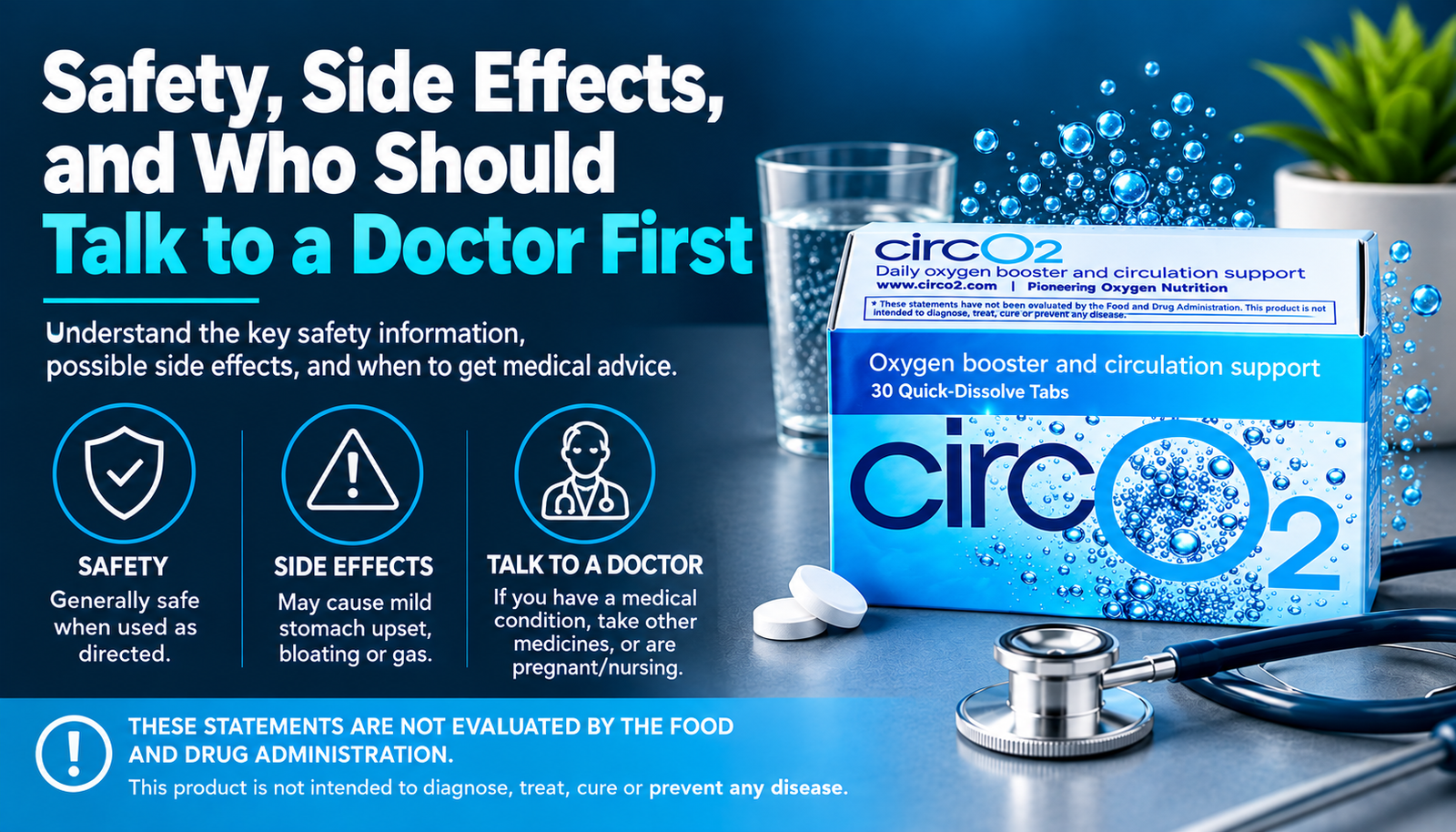
Nitric oxide supplements are generally well tolerated, but this is a particularly important section for this article's audience, and we're not going to soften it with hedged marketing language.
Nitrate Medication and Blood Pressure Drug Interactions
Talk to your doctor before starting any nitric oxide supplement if you take blood pressure medication, a nitrate medication (such as nitroglycerin for angina), or a PDE5-inhibitor erectile dysfunction medication (sildenafil/Viagra, tadalafil/Cialis, vardenafil).
This isn't a routine caution, it's a documented, FDA-labeled contraindication. Nitrate medications and PDE5 inhibitors both raise cGMP through overlapping pathways, and combining them can cause severe, potentially life-threatening drops in blood pressure. Clinical data cited in the American Heart Association's journal Circulation found that low standing blood pressure occurred in 24% of patients on placebo, compared to 46% of patients on sildenafil and 47% on tadalafil when combined with nitroglycerin. It's the strongest, most authoritative source we found on the risk of interacting with blood pressure medication, and it's the reason this section exists.
To be precise about what this does and doesn't cover: dietary nitric oxide precursors like L-arginine and L-citrulline are not considered contraindicated with PDE5 inhibitors, since they don't directly raise plasma nitrate or nitrite the way medicinal nitrates do. But nitrate medications and nitrate-based supplements or foods are a different, higher-risk category. Given the overlap and the seriousness of the risk, anyone on blood pressure medication, a nitrate medication, or an ED medication should talk to their doctor or pharmacist before starting a nitric oxide supplement of any kind, including one built around dietary nitrates or citrulline. If CircO2's hawthorn berry content is relevant to you specifically, note that hawthorn has its own separate interaction profile, notably with digoxin and other cardiac medications, so flag this alongside the nitrate question when you talk to your doctor.
Common Side Effects to Watch For
Reported side effects associated with nitric oxide-boosting supplements and precursors generally include headache, dizziness or lightheadedness, nausea, bloating, stomach discomfort, and diarrhea. Higher doses of L-arginine or L-citrulline appear more likely to cause gastrointestinal upset than lower doses. In people who are already on blood-pressure-lowering medication or who run low blood pressure at baseline, there's also a real possibility of blood pressure dropping further than intended, which is a separate consideration from the nitrate-medication interaction above and one more reason to loop in your doctor first, especially for readers managing existing health conditions.
How to Increase Nitric Oxide Naturally (Food and Lifestyle)
Supplements aren't the only lever here, and for many readers, food and movement changes are a reasonable first step or a helpful complement to any supplement.
Nitrate-rich vegetables, beets, arugula, spinach, and other leafy greens, feed the same enterosalivary pathway that converts dietary nitrate into nitric oxide. Regular aerobic activity is one of the more consistently documented ways to support healthy nitric oxide function over time; research on aging and exercise shows physically active older adults maintain higher nitric oxide bioavailability than sedentary peers of the same age, which is a meaningful finding for anyone wondering whether it's "too late" to see benefit from starting to move more. It's also worth knowing that antiseptic mouthwash disrupts the oral bacteria responsible for converting nitrate to nitrite, which can measurably reduce this pathway's effectiveness, an easy thing to overlook if you're eating nitrate-rich foods but not seeing the expected effect.
If you'd like a structured starting point, our guide to natural ways to increase your energy walks through specific foods and daily habits that support energy and metabolism together, which is a reasonable place to start before or alongside considering a supplement.
Conclusion
Nitric oxide's role in circulation and energy is real, and the science behind it (vasodilation, endothelial function, the age-related decline in NO production) is well established in peer-reviewed research. What's still developing is the evidence for specific finished supplements, including CircO2, which is why the most reliable approach is evaluating a product on its ingredients and transparency rather than the percentages on its packaging.
Based on the evidence here, CircO2's formula (L-citrulline, beetroot, hawthorn berry, B12, vitamin C, and magnesium) draws from ingredient categories with real research behind them, even though the manufacturer's specific efficacy claims aren't independently verified and shouldn't be treated as guarantees. If that evidence-informed profile fits what you're looking for, you can review CircO2's full ingredient list, current pricing, and 90-day guarantee directly.
See CircO2's full ingredient list, current offer, and 90-day guarantee on the official site. View CircO2 on the official Advanced Bionutritionals site
If you're not ready to consider a supplement yet, that's a perfectly fine place to begin, too. Start with our guide to boosting energy through food and movement first.
And if you take blood pressure medication, a nitrate medication, or an erectile dysfunction medication, please talk to your doctor before starting a nitric oxide supplement of any kind. That single conversation matters more than any ingredient list on this page.
Frequently Asked Questions
What does nitric oxide do for the body?
Nitric oxide is a signaling molecule that tells the smooth muscle in your blood vessel walls to relax, a process called vasodilation. This supports blood flow, plays a role in regulating blood pressure, and is involved in broader vascular and endothelial health.
Do nitric oxide supplements really work?
It depends on the ingredient. L-citrulline and dietary nitrates have reasonably consistent research support for improving markers like flow-mediated dilation and, in some populations, blood pressure, but evidence for finished, multi-ingredient commercial products tested as a whole is much thinner than evidence for individual ingredients.
What is the best way to increase nitric oxide naturally?
Eating nitrate-rich vegetables like beets and leafy greens, staying physically active, and avoiding habits that disrupt oral bacteria (like frequent antiseptic mouthwash use) are the most evidence-supported natural approaches, since regular movement in particular is linked to better nitric oxide function in older adults.
Can nitric oxide supplements lower blood pressure too much?
It's possible, particularly for people already taking blood pressure medication or who run low blood pressure at baseline. This is a genuine reason to talk to a doctor before starting a nitric oxide supplement if you're in either group.
Is L-citrulline better than L-arginine for nitric oxide?
For most people, yes, on the basis of absorption. L-citrulline avoids the first-pass breakdown that limits how much oral L-arginine actually reaches the bloodstream, and research shows it raises plasma arginine and supports nitric oxide synthesis more reliably.
What are the side effects of nitric oxide supplements?
Commonly reported side effects include headache, dizziness, nausea, bloating, and diarrhea, with gastrointestinal upset more likely at higher doses. Excessive blood pressure drops are a possibility for people already on blood pressure medication.
How long does it take for a nitric oxide supplement to start working?
This varies by ingredient, dose, and individual, and there isn't strong independent research establishing a reliable timeframe for finished commercial products. Manufacturer claims about very fast onset (such as CircO2's "20 minutes" claim) should be understood as marketing rather than independently confirmed research.
Is it safe for seniors to take nitric oxide supplements?
For many healthy older adults, ingredients like L-citrulline and dietary nitrates appear reasonably well tolerated, but seniors are also more likely to be on blood pressure or nitrate medications, which makes a doctor conversation before starting genuinely important rather than optional.
Does nitric oxide help with weight loss or metabolism?
Not directly. The more supported connection is indirect: better circulation and exercise capacity may make it easier to stay consistent with the physical activity that sustainable weight management depends on, rather than nitric oxide itself acting as a fat burner or metabolism booster.
Is CircO2 legit, and what's in it?
CircO2 is a real product from an established supplement company, Advanced Bionutritionals, and its ingredient list, beet root powder, hawthorn berry, L-citrulline, vitamin B12, vitamin C, and magnesium, overlaps with categories that have genuine research support. Some of the company's specific efficacy percentages in its marketing, however, could not be independently verified and should be read as manufacturer claims rather than confirmed research findings. If you take blood pressure or nitrate medication, see the Safety section above before starting CircO2 or any nitric oxide supplement, since some of its ingredients (dietary nitrates and hawthorn berry) are directly relevant to those interactions.